What RNs Really Do: Core Responsibilities in Practice
Back to Blog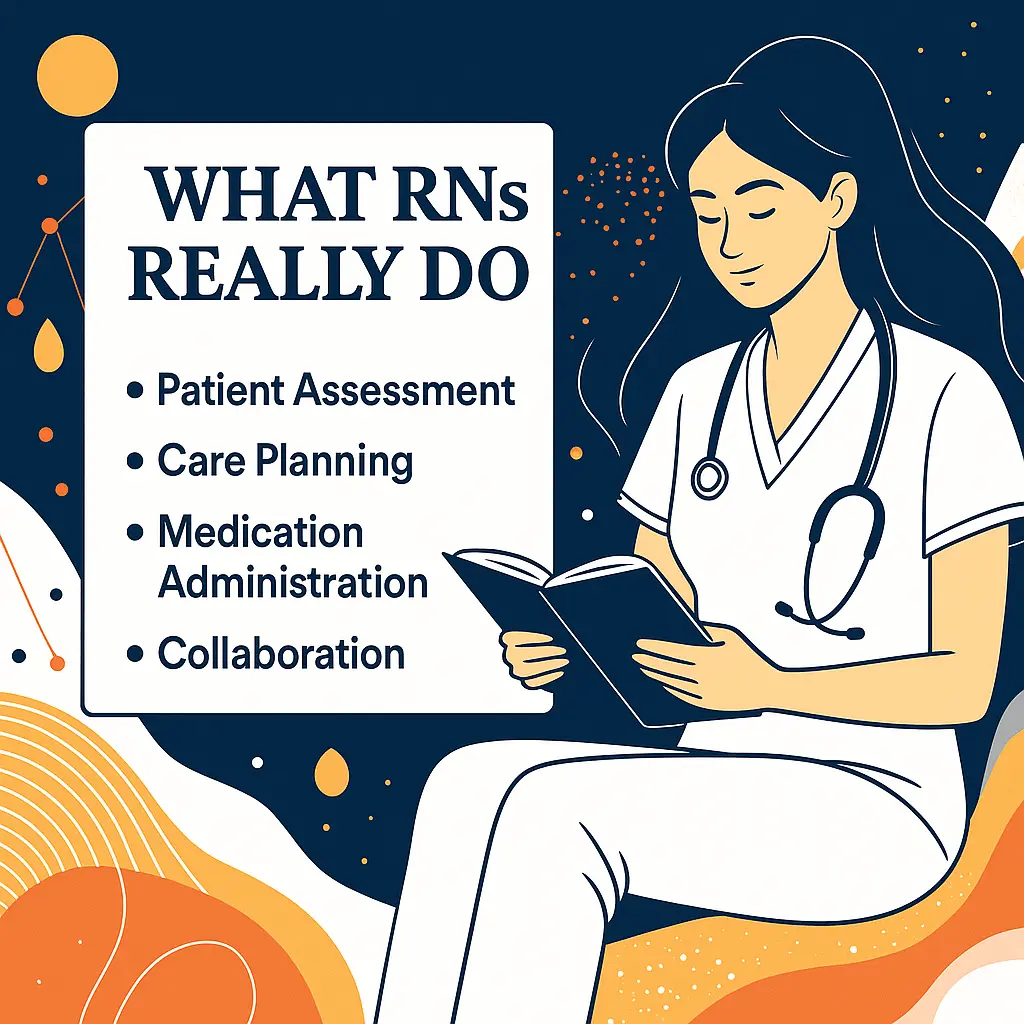
Authored by Dr. Pam Vollmer, DNP, RN, AMB-BC, NPD-BC, Accredited Provider Program Director for CE Ready
While “Registered Nurse” may sound like a straightforward job title, the role is anything but simple. RNs are the backbone of patient care, and their responsibilities are wide-ranging, technical, and often emotionally demanding. Understanding the day-to-day functions of an RN not only clarifies the scope of their practice but also showcases the profession’s indispensable value to the healthcare system.
What Nurses Need to Know
Registered nurse responsibilities extend far beyond the image most people carry of nursing. The American Nurses Association defines RN practice across six core competencies: assessment, diagnosis, outcomes identification, planning, implementation, and evaluation. In practice, those competencies translate into a nurse who simultaneously functions as clinician, coordinator, educator, and advocate, often within the same hour. According to the Bureau of Labor Statistics, registered nurses held approximately 3.4 million jobs in 2024, working across hospitals, home health, schools, telehealth, and public health. That breadth reflects a professional scope that continues to expand. Continuing education keeps every RN current with the clinical standards and regulatory requirements their license demands. CE Ready is a Florida-based ANCC-accredited continuing education provider (provider number P0986). It offers flexible, self-paced CE for LPNs, RNs, and APRNs across dozens of states at ceready.com.
It is 7:15 a.m. and Marcus, an RN on a cardiac step-down unit, has been on shift for fifteen minutes. He has already reviewed overnight vitals, caught an abnormal potassium level on a new admission, updated the care plan, and called the attending physician. His next task is admitting a post-surgical patient from recovery. When people ask what an RN does, Marcus usually just smiles. The real answer takes longer than most people expect.
The Scope of RN Practice
The American Nurses Association defines nursing practice in its Nursing Scope and Standards of Practice. That framework includes six core competencies: assessment, diagnosis, outcomes identification, planning, implementation, and evaluation. Together, they describe a role that is simultaneously clinical and relational, technical and communicative. In fact, no other credential asks one person to hold all of those responsibilities at once, on every shift.
According to the Bureau of Labor Statistics, registered nurses held approximately 3.4 million jobs in 2024. Employment is projected to grow 5 percent through 2034, with about 189,100 openings expected each year. That demand reflects something straightforward: healthcare cannot function without RNs. Furthermore, RNs practice across virtually every healthcare setting, from hospitals to schools and telehealth platforms. Therefore, understanding what RNs actually do matters for patients, families, and the nurses themselves.
Scope of practice for RNs is defined by each state’s Nurse Practice Act and guided nationally by ANA standards. Also, the National Council of State Boards of Nursing establishes the examination requirements that ensure every RN meets a consistent standard of clinical competency before entering practice. That standard sets the floor. Experience and continuing education build everything above it. Our blog on what scope of practice means for nurses covers how that framework operates in real practice.
Assessment: Where Safe Care Begins
Ask any RN what anchors her shift, and assessment will be near the top of the list. Assessment is not a task that happens once at the start of a shift and then stops. It is a continuous process that runs beneath every other clinical activity. In fact, every observation, every question, and every patient response informs the picture that guides decisions.
For RNs, assessment includes far more than vital signs. Specifically, it covers skin integrity, level of consciousness, pain quality, affect, functional status, and the subtle changes that precede deterioration. An experienced RN notices that a patient who was oriented and talkative at 0800 is slower to respond by 1000. That observation is a clinical signal. It may also be the one that prevents a rapid escalation.
Furthermore, assessment feeds the RN’s supervisory role. When an LPN reports a change or a nursing assistant notices something unusual, the RN assesses, interprets, and decides next steps. Because that function is embedded in the RN scope of practice, assessment is not a clinical luxury. It is a legal and professional responsibility. Therefore, the reasoning skills that assessment requires are exactly what the Next Generation NCLEX is designed to measure before a nurse ever enters practice.
Care Planning and Coordination
Care planning is where the RN translates assessment findings into a structured approach for what comes next. Also, it is one of the responsibilities that most clearly distinguishes the RN role from other nursing roles. An LPN can administer a medication, but cannot independently develop or modify a patient-specific plan of care. That distinction is not about hierarchy. It reflects the difference in scope and accountability.
In practice, care planning involves setting measurable goals for the patient’s recovery. It also means identifying the interventions most likely to achieve those goals. The plan accounts for the patient’s diagnosis, comorbidities, functional status, social situation, and expressed preferences. Furthermore, it changes as the patient changes. A care plan written at admission may look very different by day three.
Coordination is inseparable from planning. The RN communicates plan updates to physicians, therapists, case managers, and specialist teams. She ensures that every member of the interdisciplinary team has what they need to do their part. In addition, she advocates for the patient when care decisions do not align with what the patient has said they want. Also, she flags inconsistencies, asks questions, and pushes back when something in the plan does not add up. That coordination role is one of the most important and least visible parts of what RNs do every day.
Medication Administration and Technical Skill
Medication administration is one of the most recognized aspects of the RN role, and also one of the most technically complex. RNs administer medications through multiple routes: oral, intravenous, intramuscular, subcutaneous, and topical. Each route carries its own considerations for timing, compatibility, infusion rate, and monitoring. In fact, IV medications require the RN to understand pharmacodynamics well enough to recognize an adverse reaction early. Acting on that recognition before a situation escalates is part of the job.
Also, RNs manage IV access from initial insertion through ongoing maintenance. That includes troubleshooting infiltrations, monitoring for phlebitis, and assessing whether a central line is functioning safely. These are not simple tasks. They require a combination of technical precision and continuous clinical monitoring. Furthermore, medication errors are among the most common and most preventable causes of patient harm. That is precisely why Prevention of Medical Errors is a mandatory CE topic for Florida nurses and a core focus of patient safety education nationwide.
Beyond medications, RNs perform wound care, insert and manage urinary catheters, conduct sterile procedures, and operate specialized monitoring equipment. Specifically, the technical skills expected of an RN span from basic dressing changes to complex ventilator management in critical care. Therefore, ongoing education is not optional for maintaining those skills safely. Clinical competency has an expiration date if it is not actively maintained.
Patient Education: The RN as Teacher
Patient education is one of the most underrecognized clinical responsibilities an RN carries. In fact, teaching is embedded in the ANA’s Nursing Scope and Standards of Practice as a core implementation competency. That is not a minor addition. It reflects how central education is to patient outcomes.
At the most immediate level, patient education happens constantly during clinical care. An RN explains why a medication is changing, demonstrates how to use an incentive spirometer, or walks a family member through a wound dressing procedure before discharge. Also, she assesses what the patient already understands and adjusts her teaching accordingly. That assessment of health literacy is itself a clinical skill.
Education also extends beyond the hospital stay. In home health and outpatient settings, patient education often occupies the majority of the clinical interaction. Furthermore, the quality of that education directly affects whether patients manage their conditions safely at home. Readmission rates for chronic conditions like congestive heart failure and COPD are consistently linked to the effectiveness of pre-discharge teaching. Therefore, nursing education is not a soft add-on to clinical care. It is one of the most evidence-based interventions available.
Documentation, Accountability, and Legal Standards
Every clinical action an RN takes must be documented. That principle is not bureaucratic formality. Documentation is how care is communicated, how accountability is established, and how the legal record is maintained. In fact, the standard in nursing is simple: if it was not documented, it was not done.
Accurate, complete charting protects patients and also protects the nurse. When a care decision is challenged later, the medical record is the primary evidence of what happened, when, and why. Also, clear documentation ensures that the next clinician who cares for the patient has an accurate picture of what was done and how the patient responded. Continuity of care depends entirely on that shared record.
Documentation also connects directly to billing, accreditation, and regulatory compliance. Healthcare systems depend on accurate nursing records to substantiate care delivery and meet the standards set by accrediting bodies. Furthermore, nursing documentation is reviewed in adverse event investigations, malpractice proceedings, and licensing board inquiries. Because the stakes are that high, documentation is not just an administrative task. It is a professional and legal responsibility that RNs carry in every setting and on every shift.
Communication and Collaboration Across the Team
RNs rarely practice alone. In every setting, the RN serves as a hub for communication across the interdisciplinary team. That includes physicians, specialists, therapists, social workers, and case managers. Also, it includes patients and families, who are the most important members of the team. In fact, the RN’s ability to communicate clearly, under pressure, in real time, is central to her clinical role.
At the unit level, the RN communicates patient status changes to the attending physician, often needing to present clinical findings concisely and persuasively. That skill has a name in nursing: SBAR, which stands for Situation, Background, Assessment, and Recommendation. Furthermore, effective communication during handoff is directly linked to patient safety. Incomplete or unclear shift reports are a documented source of clinical error.
Communication also carries an advocacy dimension. When a treatment plan does not align with what the patient has expressed, the RN speaks up. When a family needs help understanding a diagnosis, the RN translates. And, when a patient cannot articulate their own needs, the RN gives them a voice. Therefore, strong communication is not a soft skill in nursing. It is a clinical tool that the RN uses on every shift, in every setting.
RN Responsibilities by Setting
The core responsibilities of a Registered Nurse stay consistent across settings. What shifts is the patient population, the pace, and the degree of autonomy. Furthermore, understanding those differences helps nurses find settings that genuinely fit their skills and professional goals.
| Practice Setting | Core Focus | What Distinguishes This Setting |
| Acute care hospital | Rapid assessment, complex treatment, care coordination | High acuity, fast pace, round-the-clock team communication |
| Home health | In-home assessment, medication management, wound care | Greater autonomy, extended patient relationships, solo visits |
| Outpatient clinic | Chronic disease management, screenings, patient education | Scheduled visits, preventive focus, regular patient contact |
| Long-term care | Daily monitoring, fall prevention, care continuity | Extended patient relationships, LPN supervision responsibilities |
| School nursing | First-line assessment, emergency response, health promotion | Often the only clinical provider students access during the day |
| Telehealth | Remote assessment, virtual triage, patient education | Technology-mediated care, geographic flexibility |
How CE Supports RN Practice
Every RN carries a continuing education requirement tied to license renewal. In Florida, RNs must complete 24 contact hours every two years. Specifically, the Florida Board of Nursing sets those requirements and mandates specific topics every renewal cycle. That mandatory content includes laws and rules, human trafficking awareness, and medical error prevention.
The CE Ready Florida page outlines exactly which topics Florida RNs must complete and which courses satisfy each requirement. Prevention of Medical Errors builds a systems-level understanding of how errors happen and how to prevent them.Human Trafficking awareness prepares RNs to recognize trafficking situations in clinical settings. Florida Laws and Rules of Nursing keeps Florida nurses current with the regulatory framework they practice within every shift. Furthermore, CE Ready’s 2026 Florida Approved RN and LPN Complete CE Renewal Bundle covers all required contact hours in one organized package, with CE Broker reporting included.
For RNs in other states, the CE Ready states directory provides a starting point for state-specific renewal requirements. Also, elective CE in communication, health equity, and cultural competence supports the patient-facing skills RNs rely on every shift. In my view, CE is most valuable when it connects directly to the clinical work you are already doing. The CE Ready course catalog covers topics that do exactly that.
Frequently Asked Questions
Q: What are the core responsibilities of a Registered Nurse?
A: Registered nurses assess patient health status, develop and manage individualized care plans, administer complex medications and treatments, educate patients and families, supervise LPNs and nursing assistants, document all clinical actions, and coordinate care across interdisciplinary teams. The specific responsibilities shift depending on the setting, but the core scope is defined by each state’s Nurse Practice Act and guided nationally by the American Nurses Association’s Nursing Scope and Standards of Practice.
Q: How is an RN different from an LPN in terms of responsibilities?
A: Both RNs and LPNs provide direct patient care, but their scopes of practice differ significantly. RNs independently assess patients, develop care plans, perform comprehensive clinical judgment, and supervise LPNs and nursing assistants. LPNs provide hands-on care within a defined scope that varies by state, typically under RN or physician supervision. RNs also carry broader legal accountability for the care delivered by those they supervise.
Q: Do RNs work outside of hospitals?
A: Yes. According to the Bureau of Labor Statistics, RNs practice in hospitals, home health agencies, outpatient clinics, schools, long-term care facilities, telehealth platforms, and public health agencies. The setting shapes how RN responsibilities look in practice, but the core competencies of assessment, care planning, education, and coordination apply across all of them.
Q: How does documentation protect an RN legally?
A: Nursing documentation creates the formal legal record of every clinical action, observation, and care decision. When a care decision or outcome is questioned later, the medical record is the primary evidence of what happened, when, and why. Accurate, complete documentation is also a patient safety tool, because it ensures that the next clinician who cares for the patient has an accurate picture of what was done and how the patient responded.
Q: What continuing education do RNs need to maintain licensure?
A: CE requirements are set by each state board of nursing. In Florida, RNs must complete 24 contact hours every two years, including mandatory topics in laws and rules, human trafficking awareness, and medical error prevention. Completions are reported through CE Broker. Nurses in other states should check their state board’s current requirements before each renewal cycle. CE Ready’s state directory and course catalog provide a practical starting point.
References
American Nurses Association. (2023). Nursing: Scope and standards of practice. https://www.nursingworld.org/practice-policy/scope-of-practice/
Bureau of Labor Statistics, U.S. Department of Labor. (2024). Registered nurses. https://www.bls.gov/ooh/healthcare/registered-nurses.htm
Florida Board of Nursing. (n.d.). Continuing education. https://floridasnursing.gov/
National Council of State Boards of Nursing. (n.d.). NCLEX examinations. https://www.ncsbn.org/