Nurse Practitioner vs Clinical Nurse Specialist Roles
Back to Blog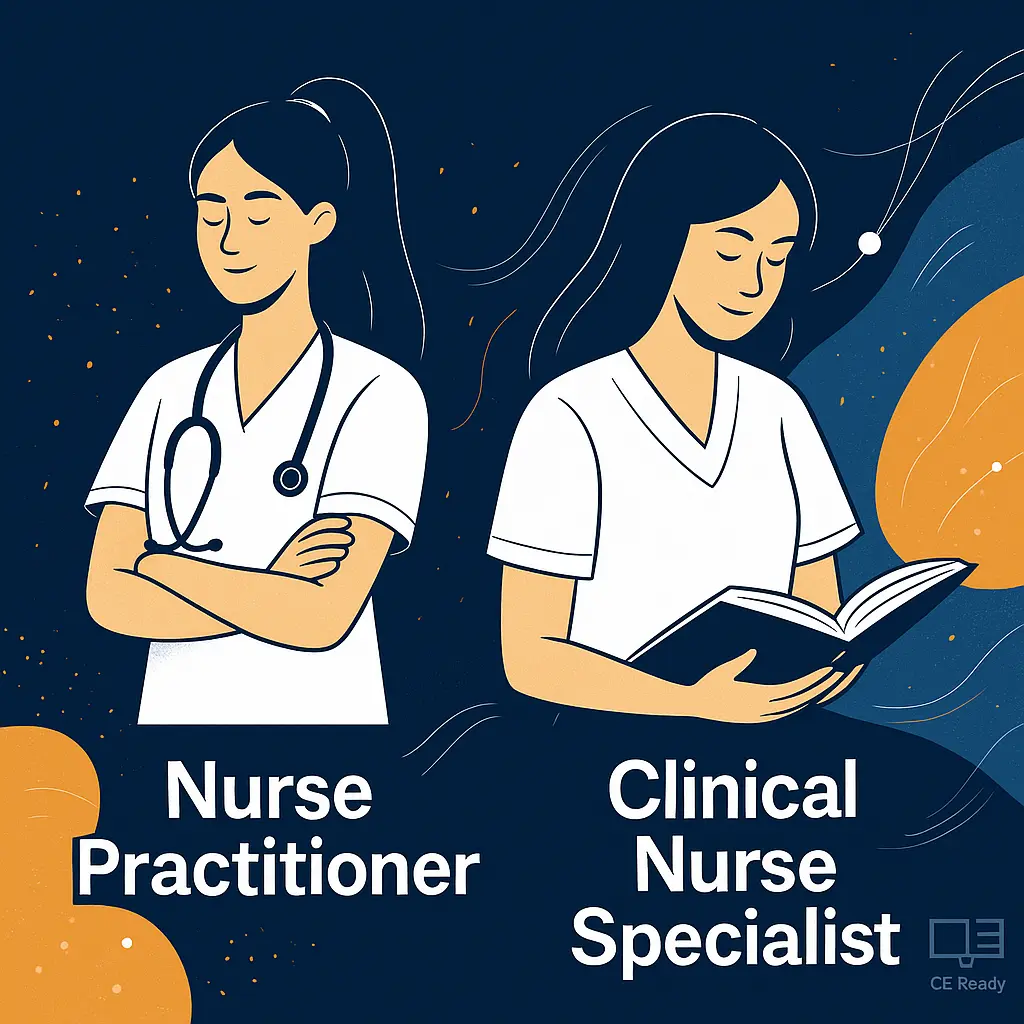
Authored by Dr. Pam Vollmer, DNP, RN, AMB-BC, NPD-BC, CEO and Director of Content at CE Ready
Navigating the world of nursing can often feel like an intricate dance between various roles and responsibilities. Among these roles, Advanced Practice Registered Nurses (APRNs), sometimes referred to as Nurse Practitioners (NPs), and Clinical Nurse Specialists (CNSs) stand out due to their advanced practice positions within the healthcare system. Understanding the distinctions between these roles is crucial for anyone considering a career in nursing or seeking to expand their professional knowledge.
In this article, we will look at the special roles and duties of Nurse Practitioners and Clinical Nurse Specialists. We will explore this topic throughout the week to highlight their differences, similarities, and the impact they have on patient care.
What Nurses Need to Know
A nurse practitioner (NP) and a clinical nurse specialist (CNS) are both advanced practice registered nurses, but each role centers on a different kind of impact. NPs focus primarily on direct patient care — diagnosing conditions, prescribing medications, and often serving as a patient’s primary provider. CNSs focus on improving care at the system level — developing evidence-based protocols, educating clinical staff, and driving quality improvement across a specialty. Both require a graduate degree and national certification, and demand for each role is growing. The key difference is where each role applies its energy: the NP at the bedside with individual patients, the CNS across systems, teams, and institutions. For APRNs in either role, continuing education is a professional requirement — and CE Ready offers ANCC-accredited CE designed for nurses practicing at this level.
At some point in most nursing careers, the conversation turns to what comes next. For many nurses, that path eventually leads to the same crossroads: nurse practitioner or clinical nurse specialist? People use the terms interchangeably, and the confusion is understandable — both are APRNs, both require graduate education, and both carry the full weight of advanced practice. But the roles are meaningfully different. Choosing between them starts with understanding exactly how.
What Is a Nurse Practitioner?
A nurse practitioner is a registered nurse who has completed graduate-level clinical training and holds an advanced practice license. NPs diagnose conditions, prescribe medications, and develop treatment plans. They order and interpret diagnostic tests — independently in many states, or in collaboration with a physician in others. Primary care, urgent care, specialty clinics, and hospital settings all employ NPs in significant numbers.
State law shapes the NP’s scope of practice in important ways. Some states grant full practice authority, meaning an NP may practice entirely without physician oversight. Other states require a collaborative or supervisory practice agreement. The National Council of State Boards of Nursing tracks APRN scope of practice regulations across states and advocates for standardized policy through the APRN Consensus Model.
Nurse practitioners earn certification through the American Nurses Credentialing Center (ANCC) or the American Association of Nurse Practitioners (AANP), depending on specialty. Examinations are specialty-specific — family practice, adult-gerontology, pediatrics, psychiatric-mental health, and women’s health are among the most common tracks. The Bureau of Labor Statistics projects NP employment will grow much faster than average for all occupations over the next decade — one of the strongest growth trajectories in the healthcare workforce.
What Is a Clinical Nurse Specialist?
A clinical nurse specialist operates in a different lane from the NP — one less focused on individual patient encounters and more focused on shaping the systems, teams, and practices that determine how care gets delivered. CNSs develop expertise in a defined specialty area: oncology, critical care, pediatrics, cardiac care, wound management, or psychiatry, among others.
The CNS role centers on three spheres of influence: the patient, the nursing team, and the healthcare system. Within those spheres, a CNS might develop or revise evidence-based protocols, work with complex patients in a consultative capacity, provide clinical education for nursing staff, or lead quality improvement initiatives. The National Association of Clinical Nurse Specialists defines this triad as the foundation of CNS practice — and it explains why CNSs are harder to count by headcount than NPs but no less essential to healthcare quality.
CNSs earn certification through the American Nurses Credentialing Center in their specialty area. Not every state separately licenses CNSs as APRNs — an area where the APRN Consensus Model and national advocacy continue pushing for regulatory consistency. Where states fully recognize CNS practice, these clinicians rank among the most credentialed and specialized professionals in any healthcare organization.
Education and Certification: How the Paths Differ
Both NPs and CNSs enter advanced practice through graduate education — typically a Master of Science in Nursing (MSN) or a Doctor of Nursing Practice (DNP). That shared foundation matters, but the curricula diverge significantly from there.
NP programs carry substantial clinical hour requirements. Students complete thousands of supervised patient contact hours, building the diagnostic reasoning and prescriptive skills that define independent practice. CNS programs emphasize specialty depth, leadership, research application, and systems thinking. A CNS candidate in oncology, for example, develops intensive expertise across the patient-nurse-system continuum — expertise that translates into protocol development, staff education, and quality leadership rather than individual appointments.
Certification follows education, and the pathways differ. NPs may certify through either the ANCC or the AANP. CNSs certify exclusively through the ANCC in their specialty area. Both credentials require ongoing continuing education to maintain — a requirement that reflects how quickly the evidence base in nursing practice changes at the clinical authority level.
The table below captures the key distinguishing features side by side:
| Nurse Practitioner (NP) | Clinical Nurse Specialist (CNS) | |
| Primary Focus | Direct patient care | System and practice improvement |
| Degree Required | MSN or DNP, NP track | MSN or DNP, CNS track |
| Certifying Bodies | ANCC or AANP | ANCC |
| Prescriptive Authority | Yes, in most states | Varies by state |
| Typical Work Settings | Clinics, hospitals, private practice | Hospitals, health systems |
| Practice Model | Primary or specialty provider | Consultant, educator, researcher |
Scope of Practice: Where NPs and CNSs Work Differently
Scope of practice is where the NP and CNS roles diverge most clearly — not just in what each provider does, but in how healthcare systems and state laws define what they may do.
Nurse practitioners carry prescriptive authority in all fifty states, though the level of independence varies. States with full practice authority allow NPs to evaluate, diagnose, treat, and prescribe without physician oversight. Other states require a collaborative practice agreement with a physician. This regulatory patchwork has been a sustained advocacy focus for NP organizations, and the trend toward full practice authority has accelerated as health systems work to address provider shortages.
Clinical nurse specialists occupy a different regulatory landscape. Some states formally license CNSs as APRNs with a defined scope of practice. Others do not recognize CNSs as a distinct APRN category under state law, making the role more dependent on institutional credentialing. Prescriptive authority for CNSs varies considerably — some states extend it, others do not. The National Association of Clinical Nurse Specialists actively advocates for greater standardization across the country.
What holds constant is the CNS’s function as an expert resource — for patients with complex needs, for nursing teams developing clinical skills, and for organizations navigating evidence-based change. The NP holds the role of direct provider. Both improve patient outcomes through genuinely different mechanisms.
Choosing the Right APRN Path
Most nurses who pursue advanced practice reach a decision point that feels enormous — and it is. The NP path leads to autonomous clinical practice, a defined patient population, and a role familiar to anyone who has experienced a provider visit. A CNS path leads somewhere less visible but equally important: influence over the quality, safety, and evidence base of care across a unit, a department, or an entire organization.
Neither role is better. They serve different professional instincts. Nurses drawn to the diagnostic relationship — to the continuity of following a patient’s care from assessment through treatment — often thrive as NPs. Nurses drawn to the bigger picture — to fixing systems, educating clinical teams, and driving practice change — frequently find CNS practice more fulfilling.
A few questions worth sitting with before you choose:
- Where do you want your daily work to live — in direct patient encounters or in the infrastructure that shapes care delivery?
- Does prescriptive authority matter to the kind of practice you envision?
- Is there a specialty area where you want to develop the deepest expertise in the building?
CE Ready offers ANCC-accredited continuing education for nurses across every level of practice, including APRNs. Whether you are working toward your next certification renewal or exploring new clinical domains, the CE Ready course library has coursework built for the complexity of these roles.
Continuing Education for NPs and CNSs
Earning an NP or CNS credential is not the finish line — it marks the beginning of a commitment to staying current. Both NPs and CNSs must complete continuing education to maintain their certifications, and most states require CE as part of the license renewal process.
The ANCC requires continuing education for certification renewal for both NPs and CNSs. AANP sets separate renewal requirements for NPs holding that certification. APRNs typically carry a higher CE load than registered nurses — a direct reflection of the independent judgment and clinical complexity their roles demand.
That load deserves quality content. Generic coursework designed for a general nursing audience rarely addresses the diagnostic, prescriptive, and systems-level decisions that APRNs navigate daily. Content built to match the depth of this level of practice makes a real difference.
CE Ready is an ANCC-accredited provider of nursing continuing professional development (Provider Number P0986) with coursework designed for the clinical complexity APRNs manage every day. Courses like Pharmacologic Management of Diabetes: Prescribing Strategies for APRNs and Advanced Anticoagulant Prescribing for APRNs go well beyond general nursing content — they address the diagnostic and prescriptive decisions that define APRN practice. CE credits apply toward license renewal in all 50 states. Browse the full library or enroll today to get started.
Frequently Asked Questions
Q: What is the main difference between a nurse practitioner and a clinical nurse specialist?
A: The primary difference is focus and function. Nurse practitioners provide direct patient care — diagnosing, treating, and prescribing — and often serve as a patient’s primary or specialty provider. Clinical nurse specialists work at the system level, developing evidence-based protocols, educating clinical staff, and improving care delivery across a specialty area. Both are APRNs who require graduate education, but the roles serve different purposes within a healthcare system.
Q: Do NPs and CNSs have the same education requirements?
A: Both roles require graduate-level nursing education — an MSN or DNP. The programs differ significantly in focus. NP programs emphasize clinical training, diagnostic reasoning, and prescriptive practice. CNS programs emphasize specialty expertise, leadership, research application, and systems improvement. Completing a graduate degree alone qualifies neither role — both require national certification after program completion.
Q: Can a Clinical Nurse Specialist prescribe medications?
A: Prescriptive authority for CNSs varies by state. Some states grant CNSs prescriptive authority comparable to NPs; others do not recognize independent prescribing rights for CNSs. Nurses in CNS roles should check directly with their state board of nursing to confirm the scope of prescriptive authority available where they practice.
Q: What certifications do NPs and CNSs need?
A: Nurse practitioners certify through the American Nurses Credentialing Center (ANCC) or the American Association of Nurse Practitioners (AANP), depending on specialty. Clinical nurse specialists certify through the ANCC in their specialty area. Both credentials require ongoing continuing education for renewal — the specific requirements vary by certifying body and state.
Q: Do APRNs in NP or CNS roles need continuing education?
A: Yes. Both NPs and CNSs must complete continuing education to maintain their certifications, and most states incorporate CE into the license renewal process. Requirements vary by certifying body and state board. ANCC-accredited providers like CE Ready offer coursework designed for the APRN level — including pharmacology, prescribing, and clinical management topics — applicable toward renewal requirements across all 50 states. Browse courses built for advanced practice at ceready.com/courses/.
References
American Association of Nurse Practitioners. (n.d.). What’s an NP? https://www.aanp.org/
American Nurses Credentialing Center. (n.d.). Certification overview. https://www.nursingworld.org/ancc/
National Association of Clinical Nurse Specialists. (n.d.). About the CNS role. https://nacns.org/
National Council of State Boards of Nursing. (n.d.). APRN regulation. https://www.ncsbn.org/
U.S. Bureau of Labor Statistics. (2024). Occupational Outlook Handbook: Nurse practitioners, nurse anesthetists, and nurse midwives. https://www.bls.gov/ooh/healthcare/nurse-anesthetists-nurse-midwives-and-nurse-practitioners.htm