How Nurses Celebrate Juneteenth: Uplifting Voices and Traditions
Back to Blog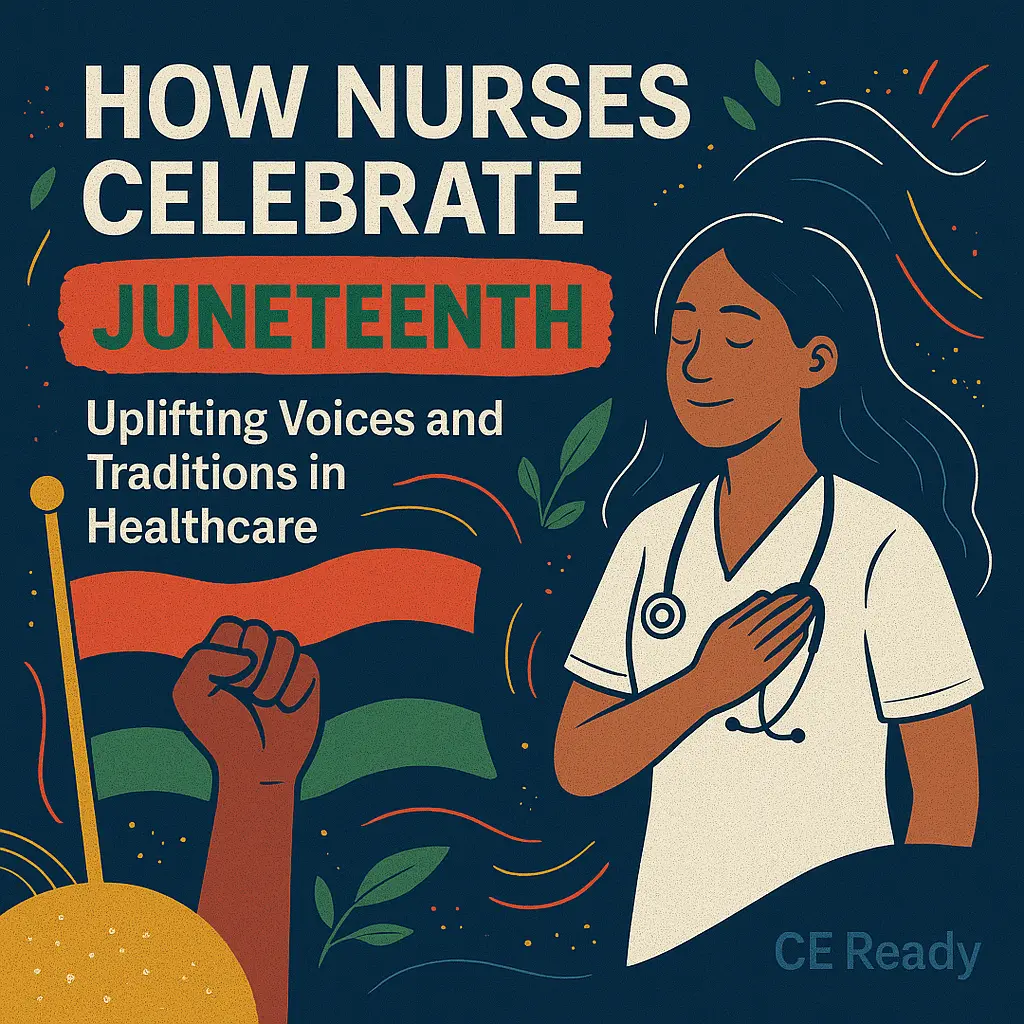
Authored by Dr. Pam Vollmer, DNP, RN, AMB-BC, NPD-BC, CEO and Director of Content at CE Ready
Juneteenth is a significant day in American history. It marks the end of slavery and the beginning of a long journey towards equality.
For nurses, particularly those of African American heritage, this day holds a special place. It’s a time to reflect on the struggles and triumphs of their ancestors.
In healthcare settings, nurses celebrate Juneteenth with a blend of education and commemoration. Nurses engage in activities that honor the past while fostering a more inclusive future.
This article explores how nurses celebrate Juneteenth. It delves into the traditions, the voices uplifted, and the lessons shared within the healthcare community.
We’ll also look at the role of Black nurses in history, the importance of cultural competency in nursing, and the ongoing efforts to advance health equity.
Join us as we uncover the unique ways nurses honor this day, fostering a deeper understanding of diversity and inclusion in healthcare.
What Nurses Need to Know
Juneteenth, observed every June 19, commemorates the day in 1865 when Union troops arrived in Galveston, Texas. They informed the last enslaved African Americans that the Civil War had ended and they were free. It was more than two years after President Lincoln signed the Emancipation Proclamation. Congress designated Juneteenth a federal holiday in 2021. For nursing, the day carries specific professional significance. Black nurses have been part of American healthcare since the Civil War era. They often served communities that lacked access to any other care and doing so under conditions of systemic exclusion. Their contributions helped build the profession’s foundations. Healthcare organizations now use Juneteenth to recognize that history, renew commitments to health equity, and deepen the cultural competency that research consistently links to better patient outcomes. Continuing education supports that work directly — and CE Ready offers ANCC-accredited courses for nurses committed to evidence-based, culturally informed practice.
Picture this: it is the morning of June 19, and your unit has put together a small Juneteenth observance. There is bulletin board of photographs, a few minutes carved out of shift change. Someone reads aloud from Susie King Taylor’s memoir. You have been a nurse for years, and you are hearing her name for the first time. That gap is exactly what Juneteenth is there to close.
What Is Juneteenth?
On June 19, 1865, Union General Gordon Granger arrived in Galveston, Texas, and read General Order No. 3 — the announcement that freedom had come. The Civil War had ended, Confederate forces had surrendered, and yet for the enslaved people of Texas, the news arrived more than two years after President Lincoln signed the Emancipation Proclamation on January 1, 1863. That delay — shaped by the absence of Union enforcement and the resistance of enslavers — meant that for hundreds of thousands of people, emancipation existed on paper but not in life. June 19 became Juneteenth: a date that holds the weight of that contradiction alongside the joy of what freedom finally meant.
African American communities have observed Juneteenth since 1865, through gatherings, storytelling, music, food, and prayer. For more than 150 years, the day sustained itself largely within Black communities even as broader American institutions ignored it. Congress changed that on June 17, 2021, when President Biden signed the Juneteenth National Independence Day Act, designating June 19 a federal holiday. That legislation recognized what African Americans already knew: this is not a footnote in American history — it is one of its defining chapters.
For nurses and healthcare organizations, the day carries meaning that extends beyond general civic recognition. The history of American healthcare runs parallel to the history of racial inequality — in who received care, who could provide it, and who trained the providers. Recognizing Juneteenth gives healthcare teams a structured opportunity to engage that history directly and to ask what it still demands of the profession today.
Black Nurses Who Shaped American Healthcare
Mary Eliza Mahoney graduated from the New England Hospital for Women and Children in 1879, becoming the first professionally trained Black nurse in the United States. Earning that credential took 16 months of intensive work — a training program that rejected the vast majority of applicants. Mahoney met every standard it set. She went on to co-found the National Association of Colored Graduate Nurses in 1908, fighting to integrate Black nurses into professional practice. Mahoney left the profession a foundational legacy: proof that Black nurses could meet every standard the work demanded.
Susie King Taylor entered nursing under circumstances that made formal training impossible. Taylor grew up enslaved in Georgia, taught herself to read and write in secret — a crime under the laws of her state — and later served as a nurse and teacher with the First South Carolina Volunteers, one of the first Black Union regiments of the Civil War. Her nursing care reached wounded soldiers without pay, without recognition, and without the institutional support that white nurses in the same era received. She published her memoir in 1902, leaving nursing one of its most direct firsthand accounts of what it cost to serve a country that refused to acknowledge that service.
Harriet Tubman’s contributions to nursing are less widely taught but equally real. During the Civil War, Tubman served Union forces as a spy, scout, and nurse — caring for soldiers and formerly enslaved people using her knowledge of the terrain and her relationships within Black communities. Her work showed that care can be an act of resistance, and that clinical knowledge exists outside formal credentials.
The National Black Nurses Association, founded in 1971, continues documenting and honoring the contributions of Black nursing professionals across generations, maintaining an institutional record that the broader profession has not always kept.
How Nurses and Healthcare Organizations Observe Juneteenth
For many nurses, Juneteenth observance happens at the unit level — a bulletin board, a short program during shift change, or a shared meal that reflects African American culinary traditions. In larger health systems, the observance often expands into structured programming. Educational panels bring in Black clinicians and historians. Staff development sessions address health disparities and culturally informed practice. Community health fairs extend the day’s impact beyond hospital walls, offering screenings and services to neighborhoods that have historically lacked consistent access to care.
Organizations that honor Juneteenth in ways that produce lasting change tend to move from events to accountability. That looks different in every institution, but common elements include:
- Hosting educational programming that features Black nursing professionals as leaders and subject matter experts, not just participants
- Committing to year-round health equity training that connects clinical decision-making to the structural factors driving disparate outcomes
- Collecting and reviewing demographic data on patient outcomes to identify and address gaps in care quality across populations
- Building a more diverse workforce through intentional recruitment, mentorship, and retention efforts
Professional nursing organizations play a central role in this work. The National Black Nurses Association coordinates national and regional events that center Black nurses’ contributions and advocate for policies that address health disparities. At the national level, the American Nurses Association has made equity in care delivery a sustained organizational priority. They recognize that a profession cannot serve all communities well if it does not understand all communities.
Juneteenth, Health Equity, and What the Data Tell Us
Health equity is not an abstract aspiration in nursing — it is a measurable goal with documented gaps. The HHS Office of Minority Health tracks racial and ethnic health disparities across the United States. Its data consistently document higher rates of maternal mortality, chronic disease burden, and limited healthcare access among Black Americans compared to white Americans. The gaps are real. They do not exist because of biological differences. Structural factors — including residential segregation, income inequality, unequal access to nutritious food, and historical medical mistreatment — drive them.
For nurses, this kind of care equity means understanding those structural drivers and factoring them into clinical decisions. A patient’s treatment adherence may reflect the cost of their medication rather than their motivation. Patient hesitancy about the healthcare system may reflect a history of that system failing them or their family. Cultural competency gives nurses the tools to make those distinctions.
Research supports this connection. The Office of Minority Health and other public health bodies have documented that culturally informed practice improves patient-provider communication, increases treatment adherence, and contributes to more equitable outcomes across diverse populations. For Black patients who have historically faced dismissal, under-treatment, and systemic bias in clinical settings, a nurse who approaches care with genuine cultural understanding makes a clinical difference — not just a relational one.
Juneteenth provides a natural point of reflection on this work. The history of Black nurses demonstrates exactly what this skill looks like in action.
Continuing Education and the Work of Cultural Competency
Cultural competency does not develop automatically. It develops through deliberate learning — exposure to perspectives, histories, and clinical experiences that extend beyond what any single practitioner’s background provides. Continuing education is one of the most reliable mechanisms for building this skill, and it serves nurses at every career stage, from new graduates to clinicians with decades of experience.
For nurses in clinical settings, cultural competency CE covers practical ground: conducting health histories that account for cultural health beliefs, recognizing and mitigating implicit bias in clinical decision-making, communicating effectively across language and cultural differences, and engaging with patients whose historical relationship with the healthcare system has made trust difficult to establish. These are not soft skills. They affect diagnoses, treatment adherence, patient safety, and outcomes.
Nurses who approach their renewal cycle thoughtfully bring current, evidence-informed practice to their patients. Cultural awareness is part of what current nursing looks like in a diverse healthcare environment. That is true regardless of specialty, setting, or patient population.
CE Ready is an ANCC-accredited provider of nursing continuing professional development (Provider Number P0986) with courses that translate directly into more equitable, more effective care. Cultural Competence and Equity and Implicit and Explicit Bias are the kind of content that Juneteenth asks nurses to complete. CE credits apply toward license renewal in all 50 states. Enroll today to get started.
Frequently Asked Questions
Q: What is Juneteenth and when is it celebrated?
A: Juneteenth, observed every June 19, commemorates June 19, 1865 — the day Union General Gordon Granger arrived in Galveston, Texas, and announced that the Civil War had ended and enslaved people were free. That announcement came more than two years after President Lincoln signed the Emancipation Proclamation. Congress designated Juneteenth a federal holiday in 2021 through the Juneteenth National Independence Day Act.
Q: Who was the first Black nurse in the United States?
A: Mary Eliza Mahoney became the first professionally trained Black nurse in the United States. She graduated from the New England Hospital for Women and Children in 1879. Mahoney later co-founded the National Association of Colored Graduate Nurses. There she worked to integrate Black nurses into mainstream professional practice and advocated for equal standing within the profession.
Q: How do healthcare organizations meaningfully observe Juneteenth?
A: Meaningful observance goes beyond a single event. Healthcare organizations that honor Juneteenth substantively host educational panels featuring Black clinicians and historians, hold staff development sessions on health disparities and culturally informed care, engage in community health outreach in underserved areas, and commit to year-round equity initiatives. The most impactful organizations also build internal accountability — tracking workforce diversity, patient outcome disparities, and the reach of equity-focused programs — to ensure that Juneteenth conversations translate into sustained change.
Q: What is cultural competency in nursing, and why does it matter?
A: Cultural competency in nursing means understanding and working within a patient’s cultural context — including their health beliefs, communication preferences, and relationship with the healthcare system — to provide care that is accurate, respectful, and effective. Research consistently links this skill to improved patient outcomes, including stronger treatment adherence, better diagnostic accuracy, and more trusting patient-provider relationships. For nurses, cultural competency is a clinical skill, not a courtesy.
Q: How can continuing education help nurses develop cultural competency?
A: Continuing education gives nurses structured exposure to perspectives, clinical scenarios, and frameworks they may not encounter in their daily practice environment. CE courses covering topics like implicit bias, health disparities, and culturally informed communication help nurses recognize assumptions that affect care and develop practical tools for serving diverse patient populations. The most effective CE connects directly to clinical practice — not just awareness, but applicable skills. ANCC-accredited providers like CE Ready offer coursework in professional development and clinical practice across all nursing levels — including Cultural Competence and Equity in Nursing Practice and Implicit and Explicit Bias in Healthcare. Browse the full course library at ceready.com/courses/.
References
American Nurses Association. (n.d.). Diversity, inclusion, and equity. https://www.nursingworld.org/
HHS Office of Minority Health. (n.d.). Minority population profiles. https://minorityhealth.hhs.gov/
Library of Congress. (n.d.). Juneteenth. https://www.loc.gov/
National Black Nurses Association. (n.d.). About NBNA. https://www.nbna.org/