Real Nurse Heroes: Susie King Taylor:First Black Army Nurse
Back to Blog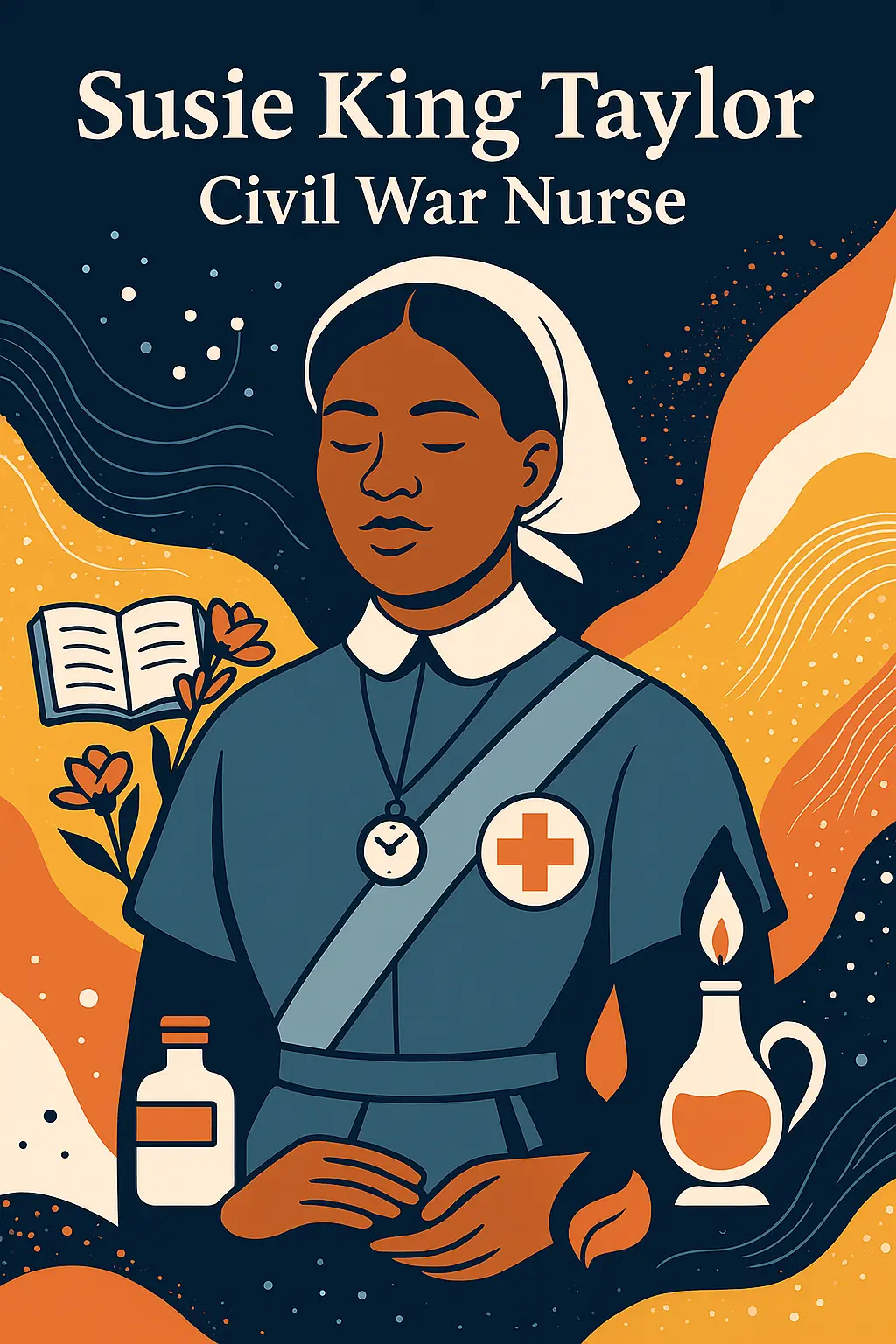
Authored by Dr. Pam Vollmer, DNP, RN, AMB-BC, NPD-BC, CEO and Director of Content at CE Ready
Long before civil rights laws were written, and decades before Black nurses were widely accepted in professional healthcare roles, Susie King Taylor broke barriers with quiet strength and undeniable skill. Born into slavery in 1848, she would go on to become the first African American Army nurse in the United States, not just caring for the wounded but educating freed slaves and documenting a war few dared to write about.
This Nurses Week, we honor her not just as a nurse but as a teacher, advocate, and pioneer whose story still inspires nurses across the country, particularly those working toward LPN continuing education, diversity in healthcare, and educational outreach in underserved communities.
What nurses need to know
Susie King Taylor was born into slavery in 1848 near Savannah, Georgia, and became the first African American Army nurse in United States history. At 14, she joined the 1st South Carolina Infantry — one of the first all-Black Union regiments — providing nursing care, teaching literacy to freed people, and serving without military pay or official recognition. Her 1902 memoir, Reminiscences of My Life in Camp, remains the only known Civil War account written by a Black woman who served on the front lines. Taylor’s story belongs to every nurse who believes that clinical care and advocacy for human dignity are inseparable. CE Ready is an ANCC-accredited CE provider (P0986) based in St. Petersburg, FL, with courses covering health equity, cultural competence, and professional advocacy that carry forward the values Taylor embodied.
Susie King Taylor learned to read from a free Black woman named Mrs. Woodhouse, in secret, in Savannah, Georgia — at a time when teaching an enslaved person to read was a crime. That education would become the backbone of everything she accomplished. It gave her access to information. It gave her the ability to document her own experience. Above all, it gave her a way to serve.
At 14, she escaped to Union lines with her uncle and dozens of others. She never looked back. Within weeks, she was caring for wounded soldiers and teaching freed adults and children to read. Both were forms of nursing. Both were forms of advocacy. Taylor never separated the two.
Who Susie King Taylor Was
Susie Baker was born on August 6, 1848, on a Georgia plantation. Her grandmother, Dolly Reed, arranged for her and a brother to travel secretly to Savannah for schooling. Mrs. Woodhouse, and later a young man named James Blouis, taught her to read and write — both at personal risk. That foundation shaped the nurse, teacher, and writer she would become.
In April 1862, she reached Union lines on St. Simon’s Island, Georgia. Shortly after, she joined the 1st South Carolina Infantry as it organized into one of the war’s earliest Black regiments. The regiment later became the 33rd United States Colored Troops in early 1864. Taylor remained with the regiment throughout her service, working as a laundress, teacher, and nurse simultaneously.
She received no military pay for her nursing work. No official rank. No formal recognition from the United States government during her lifetime. Still, she served.
Susie King Taylor: A Timeline
| Year | Event | Significance |
| 1848 | Born on a Georgia plantation | Life begins under slavery |
| Late 1850s | Secretly taught to read and write | Foundation for everything that followed |
| 1862 | Reaches Union lines; joins 1st SC Infantry | Begins military nursing service at age 14 |
| 1862-1865 | Nurses wounded soldiers; runs literacy schools | Combines clinical care with educational advocacy |
| 1864 | Regiment reorganized as 33rd USCT | Continues service through the war’s end |
| 1866 | Opens a school for freed people in Savannah | Extends education work after the war |
| 1902 | Publishes Reminiscences of My Life in Camp | Only known Civil War memoir by a Black woman who served on the front lines |
| Present | Recognized as the first Black Army nurse in U.S. history | Legacy shapes nursing history and health equity |
Her Service During the Civil War
Taylor joined a regiment forming in conditions that were difficult by any measure. Supplies ran short. Medical resources were improvised. The soldiers she cared for faced both battlefield wounds and the diseases that killed far more Civil War soldiers than combat did.
Her nursing methods combined the practical knowledge she had accumulated with whatever materials were available — herbal remedies, basic wound care, improvised supplies. She moved across the field without hesitation. She worked alongside Clara Barton, who later founded the American Red Cross, during periods of intense casualty care.
Additionally, Taylor ran literacy classes for soldiers in the regiment throughout the war. Education and nursing ran parallel in her mind, and she pursued both with equal commitment. Many of the men she taught had never held a book. By the time they left her, they could write their own names and read simple texts. That literacy changed what they could claim for themselves in the years ahead.
Reminiscences of My Life in Camp
In 1902, Taylor published her memoir — the only known Civil War account written by a Black woman who served in a front-line capacity. The book is direct, specific, and unflinching. It describes battlefield conditions, the bonds between soldiers and caregivers, the racism Taylor encountered both during and after the war, and the particular experience of Black women whose service went unacknowledged by the institutions they served.
Taylor dedicated sections of the memoir to the soldiers she had cared for and to the injustice of a country that celebrated their sacrifice while denying them basic civil rights in the decades after the war. She wrote with clarity and moral authority, and without bitterness. The memoir remains a primary historical source for anyone studying Black military service, Civil War nursing, or the early history of African American healthcare.
No government pension ever reached her. No formal military recognition came during her lifetime. The book was her record, her testimony, and her act of professional accountability.
A Voice for Education and Empowerment
After the war, Taylor returned to Savannah and opened a school for freed people. She taught adults and children, continuing the work she had started in the field. The school operated on the same principle that had guided her nursing: every person deserved access to the tools needed to live fully.
Later she moved to Boston, married Russell Taylor, and became active in the Women’s Relief Corps — an auxiliary of the Grand Army of the Republic. She organized support for Black veterans who faced discrimination in the pension system and in veterans’ organizations. Throughout, she remained a person who understood that care and advocacy could not be separated.
Her belief that education and healthcare were twin pillars of human dignity anticipates much of what modern nursing now formally recognizes. Cultural competence, health equity, social determinants of health — these frameworks carry forward what Taylor practiced without any of that language available to her.
Why Her Story Matters for Nurses Today
Taylor’s story holds specific professional meaning for nurses across every specialty and setting.
She practiced without institutional support and without compensation. Many nurses today serve in underresourced environments, advocate for patients facing systemic inequities, or mentor colleagues from marginalized backgrounds. Her example shows that meaningful clinical and educational work is possible even when the system provides nothing.
She documented her experience with precision and honesty. Nurses who write about their work — in reflective practice, in professional journals, in public health advocacy — carry forward that same commitment to testimony. Her memoir proved that a nurse’s account of her own experience deserves a permanent place in the historical record.
She never separated care from advocacy. The patients she nursed and the students she taught were the same population — people whose full humanity the dominant culture refused to recognize. For nurses who work at the intersection of clinical care and social justice, Taylor offers a model that predates modern language for that work by more than a century.
Continuing education in health equity, cultural competence, and professional advocacy develops the competencies her example calls forward. The nurses who inherit her legacy most fully are those who understand that excellent clinical care and fierce patient advocacy belong together — not as separate professional aspirations, but as a single professional commitment.
Frequently Asked Questions About Susie King Taylor
Who was Susie King Taylor?
Susie King Taylor was an African American nurse, teacher, and writer born into slavery in 1848 in Georgia. During the Civil War, she served with the 1st South Carolina Infantry and later the 33rd United States Colored Troops, providing nursing care to wounded soldiers and teaching literacy to freed people — all without pay or official military rank. After the war, she opened schools for freed people in Savannah. In 1902, she published Reminiscences of My Life in Camp, the only known Civil War memoir written by a Black woman who served on the front lines.
Why is Susie King Taylor considered the first Black Army nurse?
Taylor provided direct nursing care to soldiers of the 1st South Carolina Infantry — one of the Union Army’s first all-Black regiments — beginning in 1862. At the time, no official Army Nurse Corps existed, and no formal mechanism recognized her clinical work with military designation or compensation. Historical research has established her as the first African American woman to serve as an Army nurse in a documented front-line capacity. The United States government did not formally acknowledge her service during her lifetime.
What was Susie King Taylor’s memoir about?
Reminiscences of My Life in Camp, published in 1902, is Taylor’s firsthand account of her Civil War service. The book describes battlefield conditions, the nursing care she provided, the literacy education she delivered to soldiers, and the racism she encountered both during and after the war. She wrote about the injustice of a country that denied Black veterans basic civil rights in the postwar decades. The memoir remains a primary historical source for scholars of Civil War nursing, Black military history, and African American women’s experience in the 19th century.
How does Susie King Taylor’s legacy connect to modern nursing?
Taylor’s legacy connects to modern nursing through three threads that remain central to professional practice: the inseparability of clinical care and patient advocacy, the obligation to serve without letting institutional barriers define the limits of one’s commitment, and the importance of documenting nursing experience as part of the professional record. Contemporary frameworks for health equity, cultural competence, and social determinants of health carry forward what Taylor practiced intuitively more than 150 years ago.
Did Susie King Taylor receive recognition for her military service?
Not during her lifetime. Taylor received no military pay for her nursing work, no official rank, and no government pension. The United States government denied her pension claims. She documented this injustice explicitly in her memoir, contrasting the country’s celebration of Union victory with its treatment of the Black soldiers and caregivers who had made that victory possible. Historical recognition came decades later, long after her death in 1912.
What can nurses learn from Susie King Taylor’s example?
Taylor’s example teaches that clinical excellence and human advocacy are not competing values — they reinforce each other. She also demonstrated that professional purpose does not require institutional validation. She served, taught, and documented with precision and integrity whether or not anyone in authority recognized her work. For nurses who navigate under-resourced environments, systemic inequities, or professional invisibility, her story provides a model of sustained commitment that has lost none of its relevance.
References
American Nurses Association. (2024). Nursing history and professional development. https://www.nursingworld.org/
National Academy of Medicine. (2010). The future of nursing: Leading change, advancing health. https://nap.nationalacademies.org/
National Archives. (2024). United States Colored Troops records. https://www.archives.gov/
National Council of State Boards of Nursing. (2024). Nursing professional standards. https://www.ncsbn.org/
Taylor, S. K. (1902). Reminiscences of my life in camp with the 33rd United States Colored Troops. Boston: Published by the author.