Thermal Imaging Used to Assess Emotional Competence in Nursing Students
Back to Blog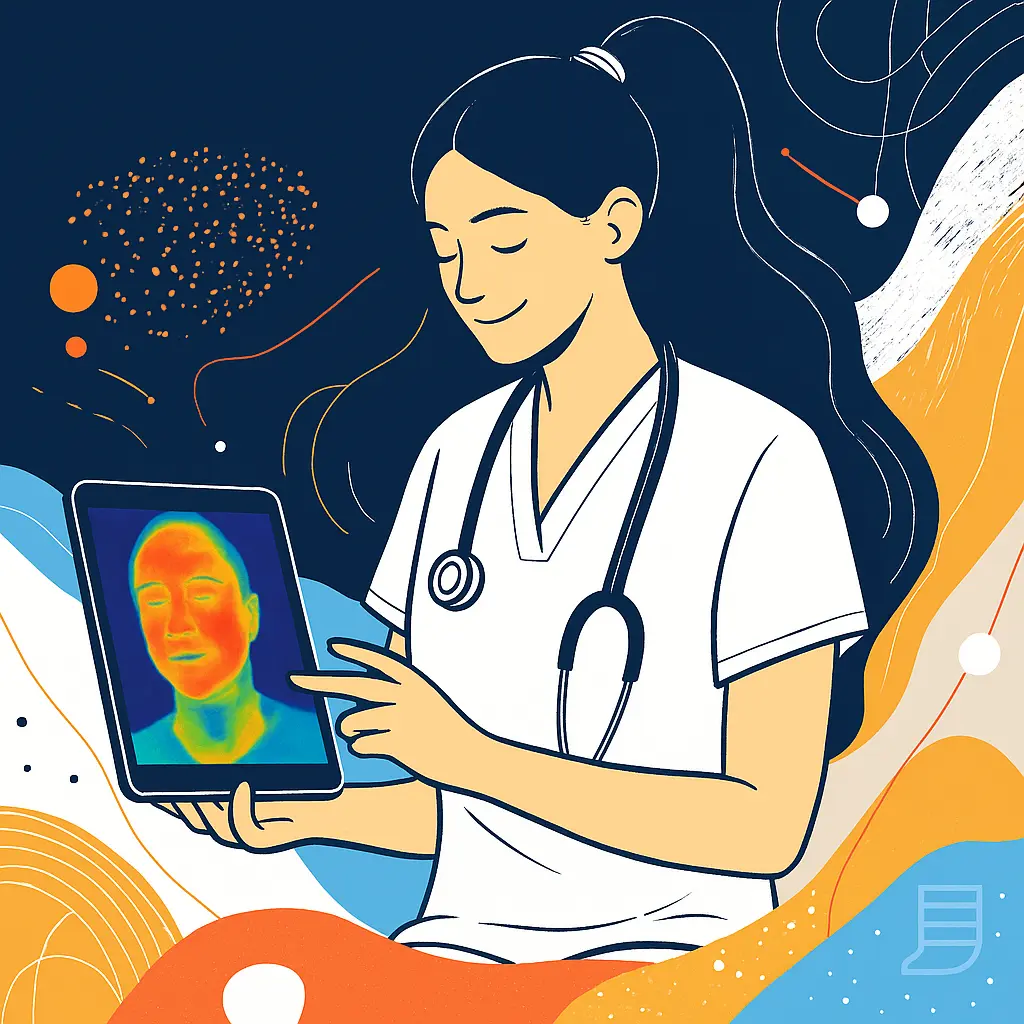
Authored by Dr. Pam Vollmer, DNP, RN, AMB-BC, NPD-BC, Accredited Provider Program Director for CE Ready
Emotional competence refers to the ability to recognize, interpret, and respond constructively to emotions in oneself and others. This skill is pivotal for nurses, who must navigate emotionally charged situations with sensitivity and professionalism. Enhancing emotional competence among nursing students is essential to ensure they are well-prepared for real-world challenges.
What Nurses Need to Know
Emotional competence — the ability to recognize, manage, and respond constructively to emotions in yourself and your patients — is one of the most clinically significant skills you can develop. It shapes patient satisfaction, treatment adherence, therapeutic relationships, and your own long-term resilience. Researchers in nursing education are now applying thermal imaging technology to measure emotional responses during simulation, capturing skin temperature changes that reflect emotional arousal in real time.
A 2020 study published in Sensors found that distinct facial temperature changes correspond to specific emotional states, providing an objective window into how nursing students respond under clinical pressure (Marqués-Sánchez et al., 2020). The core message for nurses at every career stage: emotional competence is not a personality trait you either have or don’t. It can be taught, measured, and strengthened.
CE Ready, an ANCC-accredited continuing education provider (Provider Number P0986), offers courses in communication and professional development that build the skills at the heart of emotional competence. Browse what’s available at ceready.com/courses.
You are forty-five minutes into your shift when a patient’s adult daughter finds you at the nurses’ station. Her mother is scared, she says. She doesn’t understand what’s happening. All of that fear is coming straight at you, and you have a choice: hand over a clinical summary, or actually connect. How you respond in the next sixty seconds — whether you stay regulated, stay present, stay genuinely empathetic — will shape whether this family trusts you for the rest of the admission. That quiet moment of emotional skill is harder to teach than wound care and harder to measure than medication accuracy. And researchers are now finding new ways to do exactly that.
What Emotional Competence Actually Means
Emotional competence is the ability to recognize emotions — yours and your patients’ — understand what they signal, and respond in a way that moves the situation forward. It is not the same as being warm or naturally likable. It is a specific, learnable set of skills.
The three core components are emotional awareness, emotional regulation, and empathy.
Emotional awareness is the ability to notice and name what you’re feeling in real time — and to read the same signals in the people around you. In practice, it shows up when you catch a flicker of fear in a patient’s expression before they’ve found the words, or when you notice your own frustration beginning to color your tone.
Emotional regulation keeps your behavior rooted in your values when a patient lashes out from fear, when a family member demands answers you don’t have, or when a colleague’s attitude is testing your patience. It doesn’t mean suppressing your feelings. It means not letting your feelings run the show.
Empathy in clinical practice goes beyond sympathy. It’s the active effort to understand a patient’s experience from inside their perspective. It transforms a technically correct interaction into one the patient later describes as genuinely caring.
These three skills operate in every conversation during your shift — with patients, family members, physicians, and colleagues — whether or not you are thinking about them. They are not extras. They are the foundation of therapeutic care.
Why Emotional Competence Is More Than a Soft Skill
The nursing literature has spent decades confirming what experienced nurses already know: how you connect with patients matters clinically, not just interpersonally.
Patients who feel genuinely heard show higher rates of treatment adherence. They communicate concerns more readily, which means changes in condition get caught earlier. They follow discharge instructions more consistently. And they report higher satisfaction scores — metrics that increasingly affect hospital reimbursement and public-facing ratings.
For nurses themselves, stronger emotional regulation is directly linked to lower rates of burnout. Research by Görgens-Ekermans and Brand (2012), published in the Journal of Clinical Nursing, found that emotional intelligence acts as a meaningful buffer between workplace stress and burnout. Nurses with higher emotional intelligence also report longer career longevity and greater job satisfaction. When you have the skills to process what you’re carrying, each shift’s emotional load is less likely to accumulate in ways that eventually cost you your health or your career.
There is a team dimension too. Care teams with higher collective emotional intelligence communicate more clearly and navigate conflict more constructively. When everyone can manage their own state and read the room, the team performs better under pressure.
The American Nurses Association recognizes communication and interpersonal skills as core to nursing practice standards. Emotional competence belongs in the same professional development conversation as clinical skill-building — not in a separate category labeled soft.
Why Emotional Competence Is Difficult to Teach and Measure
Here is the challenge nursing educators have been working to solve: emotional competence is central to excellent care, but genuinely difficult to assess objectively.
You can evaluate wound care against a skill checklist. You can run a code scenario and measure response time, medication accuracy, and team communication. But assessing whether a student is genuinely regulating anxiety during that scenario — rather than suppressing it in ways that contribute to burnout later — is much harder to capture. The skill matters enormously. The measurement tools have not kept up.
Traditional assessment methods have real limits. Self-report surveys let students rate their own emotional skills, but research consistently shows that people overestimate their abilities — particularly where they have the least experience. Faculty observation during simulation is the other standard approach. But it’s inconsistent. What one educator reads as emotional dysregulation, another may interpret as focused intensity. Neither method gives educators reliable, actionable data.
This gap between the clinical importance of emotional competence and the ability to measure it objectively is exactly what thermal imaging research is working to close. It is not a small gap. It is the reason nurses can graduate clinically proficient while still underprepared for the emotional demands of the job.
What Thermal Imaging Reveals
Thermal cameras detect infrared radiation — the heat your body naturally emits — and convert it into a real-time visual image. The result is a dynamic map of skin temperature across the face, neck, and hands.
That map reflects emotional state in measurable, predictable ways.
When you experience stress or emotional arousal, your sympathetic nervous system activates and blood flow shifts. Specific areas of skin — particularly the nose, cheeks, and forehead — show temperature changes that correspond to different emotional states. These physiological responses occur whether or not you are aware of them, and whether or not you are actively working to appear calm.
A 2020 study published in Sensors applied thermographic cameras to nursing students during emotional stimuli (Marqués-Sánchez et al., 2020). Researchers measured facial temperature changes across three phases: acclimatization, stimulus, and response. They found distinct, measurable temperature differences between positive emotions like joy and negative emotions like anger. Forehead temperatures varied predictably between the two states. The researchers proposed integrating thermography into simulation-based nursing education as a practical tool for monitoring and developing emotional competence.
The technology does not replace clinical judgment. It adds a physiological layer that was not previously available. That layer changes the quality of the debrief. Instead of general impressions, educators have specific data showing exactly when emotional activation peaked — and what was happening in the scenario at that moment.
How Nursing Programs Are Using This Technology
Thermal imaging in nursing simulation is still emerging, with most published research coming from European programs. But the principles it surfaces apply to simulation-based education broadly.
| Application | What It Looks Like in Practice |
| Targeted debrief | Thermal data pinpoints when a student’s stress peaked, giving the debrief a specific starting point instead of general impressions |
| Building self-awareness | Students see the gap between how composed they felt and what their physiology showed — that gap is where growth begins |
| Reducing evaluator inconsistency | Objective physiological data reduces variability between faculty observers, supporting more consistent student assessment |
| Simulation integration | No new scenario design is required — thermal cameras run alongside existing simulation infrastructure |
The National League for Nursing has long positioned simulation as a cornerstone of nursing education. Thermal imaging fits naturally into that framework. The goal — helping students understand and regulate emotional responses during high-stakes scenarios — aligns directly with simulation’s established educational purpose.
Even without cameras, the underlying principle holds. Emotional responses during simulation deserve deliberate, objective attention in debriefs. Structured observation frameworks and reflective debriefs are available to any program today. The technology is one path. The principle is the destination.
What This Means for Nurses in Practice
You may be reading this and thinking: interesting research, but that sounds like a nursing school problem. Here is why it matters to you right now.
If you work as a preceptor, charge nurse, or unit educator, understanding how emotional competence develops — and what gets in its way — makes you a more effective mentor. The same patterns that appear as thermal signals in students show up in experienced nurses too. Naming them and creating space for growth benefits every level of your team.
The research also reinforces something most experienced nurses already know: emotional competence is not fixed at graduation. Understanding your own emotional patterns — through reflection, mentorship, peer conversation, or CE — pays real dividends over time. Growth is always available. That matters.
Patient experience metrics are playing a larger role in hospital evaluations than at any previous point, with direct ties to reimbursement. How nurses connect with patients is being measured formally, and that trend is not slowing down. Being intentional about emotional competence now is an investment in both patient outcomes and your professional standing.
CE Ready, an ANCC-accredited continuing education provider (Provider Number P0986), offers courses in communication and professional development that build the skills at the core of emotional competence in everyday nursing practice. Find courses that meet your state’s requirements at ceready.com/states.
Building Emotional Competence at Any Career Stage
Thermal imaging belongs to nursing education research. For nurses in practice, emotional competence grows through a different set of strategies — and they are accessible at any stage of your career.
Four approaches are consistently supported by the nursing and psychology literature:
Reflective practice. Five minutes after a difficult interaction — asking what you were feeling, how it shaped your response, and what you might do differently — is one of the most evidence-supported tools for emotional growth. Brief written reflection at the end of a shift strengthens the habit of noticing over time. It doesn’t have to be formal. It just has to be honest.
Peer debrief. The structured reflection that follows simulation can happen informally between colleagues. A culture where nurses can say “that interaction hit me harder than I expected” — and be heard, not dismissed — builds collective emotional competence across the whole team. This kind of culture starts with one person willing to say it first.
Continuing education. Formal CE on therapeutic communication, conflict resolution, and professional resilience gives you frameworks that support emotional competence in real clinical situations. CE Ready’s ANCC-accredited courses (Provider Number P0986) address these areas directly. Explore options at ceready.com/states.
Self-awareness practices. Understanding your personal stress signals — what triggers you, how emotional activation shows up in your body, how long recovery typically takes — builds the foundation for effective regulation. Mindfulness practices have solid evidence behind them in nursing populations. They can be incorporated into even the most packed clinical day in small, practical steps.
Frequently Asked Questions
Q: What is emotional competence in nursing, and how is it different from emotional intelligence?
A: Emotional competence and emotional intelligence are related terms often used interchangeably in nursing literature. Emotional intelligence refers to the broader capacity to perceive, understand, and manage emotions. Emotional competence is the applied, behavioral expression of that capacity — the specific skills demonstrated in practice, such as recognizing a patient’s distress, regulating frustration during a difficult interaction, and responding with genuine empathy. In clinical education, emotional competence is often preferred because it emphasizes observable, teachable behaviors rather than an innate personality trait.
Q: Can nurses improve their emotional competence, or is it something you either have or don’t?
A: Emotional competence can be developed and strengthened at any career stage. Research consistently shows that reflective practice, mentorship, communication training, and continuing education improve emotional awareness, regulation, and empathy over time. Thermal imaging research supports this directly — emotional physiological responses measured during simulation change with training. That is strong evidence these responses are trainable, not fixed.
Q: How does emotional competence affect patient outcomes?
A: Strong emotional competence in nurses is associated with higher patient satisfaction, better treatment adherence, and more effective therapeutic relationships. When patients feel genuinely heard and cared for, they communicate more openly, follow treatment plans more consistently, and report concerns earlier — all of which contribute to better clinical outcomes. Higher nurse emotional competence is also linked to lower burnout rates, which supports consistency and quality of care over the long term.
Q: Is thermal imaging technology available in most nursing programs?
A: Not yet. Thermal imaging in nursing education is an emerging area of research, currently concentrated in select programs, primarily in Europe. The technology is becoming more portable and affordable, but widespread adoption is likely still several years away. The more important takeaway for most programs today is the principle: emotional competence deserves objective assessment and deliberate development in simulation debriefs, regardless of the specific technology used.
Q: What continuing education options support emotional competence for practicing nurses?
A: CE Ready offers ANCC-accredited continuing education (Provider Number P0986) in communication and professional development — areas that directly strengthen emotional competence in clinical practice. Browse available courses and find options that meet your state’s CE requirements at ceready.com/states.
References
American Nurses Association. (2021). Nursing: Scope and standards of practice (4th ed.). American Nurses Association. https://www.nursingworld.org/practice-policy/scope-of-practice/
Görgens-Ekermans, G., & Brand, T. (2012). Emotional intelligence as a moderator in the stress–burnout relationship: A questionnaire study on nurses. Journal of Clinical Nursing, 21(15–16), 2275–2285. https://doi.org/10.1111/j.1365-2702.2012.04171.x
Marqués-Sánchez, P., Liébana-Presa, C., Fernández-Martínez, M. E., Hidalgo-Blanco, M. Á., García-Alonso, J., & Benítez-Andrades, J. A. (2020). Thermal infrared imaging to evaluate emotional competences in nursing students: A first approach through a case study. Sensors, 20(9), 2502. https://doi.org/10.3390/s20092502
National League for Nursing. (n.d.). Simulation in nursing education. https://www.nln.org/education/training/professional-development-programs/simulation