Texas Nurses Report Workplace Violence at Alarming Rates
Back to Blog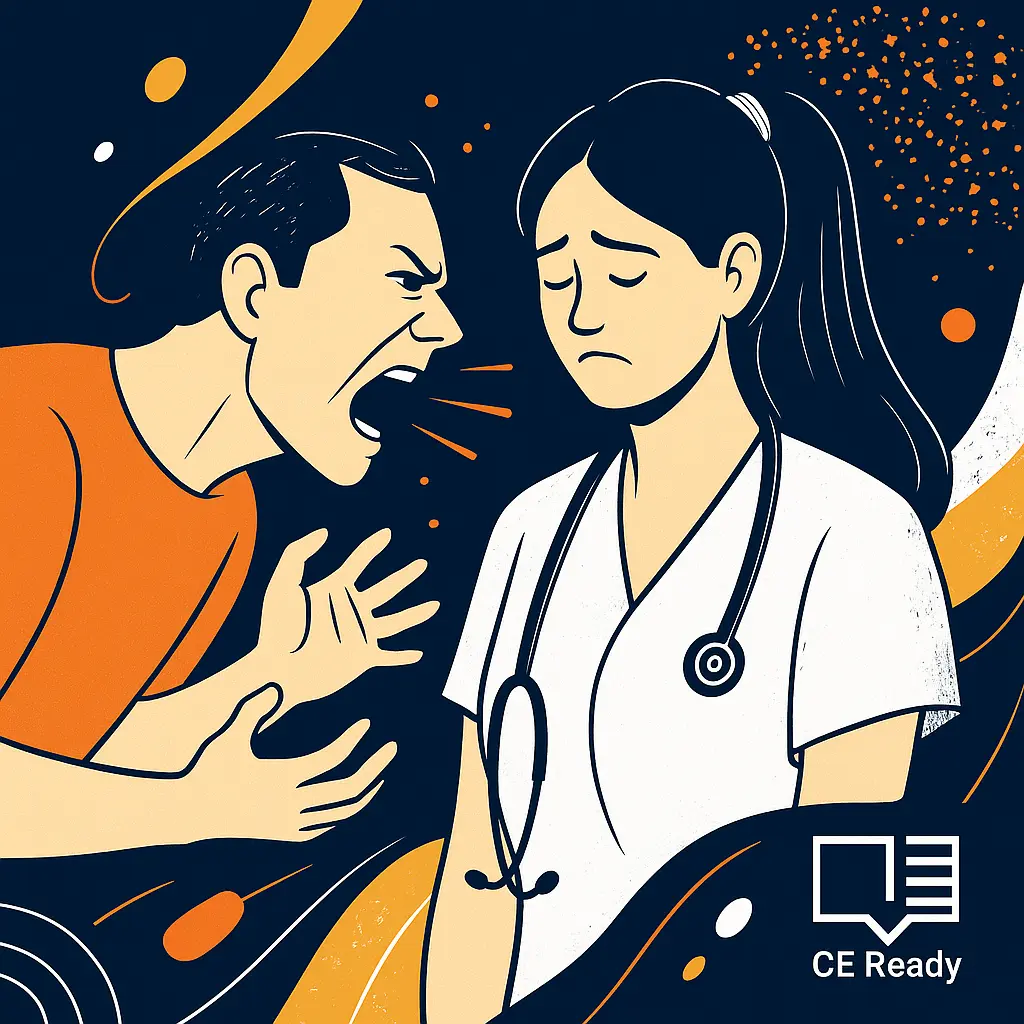
Authored by Dr. Pam Vollmer, DNP, RN, AMB-BC, NPD-BC, CEO and Director of Content at CE Ready
What Nurses Need to Know
Workplace violence in nursing — which includes physical assault, verbal abuse, sexual harassment, and bullying from patients, visitors, or colleagues — is not a rare occurrence. A 2024 survey by National Nurses United of 914 nurses found that 81.6% experienced at least one form of workplace violence in 2023 alone. Healthcare workers overall account for a disproportionate share of workplace violence nationally, and nurses are among the most vulnerable due to direct patient contact, high-stress environments, and a professional culture that has historically normalized these incidents as “part of the job.”
The consequences reach beyond individual nurses. Workplace violence contributes directly to burnout, turnover, and reduced quality of patient care. Every nurse deserves a safe workplace. And every patient deserves care delivered by a nurse who has not just survived a shift but was actually supported through it. This post covers what workplace violence looks like in nursing, who it affects, and what meaningful change requires.
She had been a nurse for eleven years when she decided she was done. Not because the work had stopped mattering — it had never stopped mattering. But after the third incident in two months — a patient who grabbed her arm hard enough to bruise, a family member who followed her into the hallway to scream at her, a colleague who undermined her in front of the team until she stopped speaking up altogether — she quietly updated her resume and started looking for something outside the hospital. She was not the nurse her unit could afford to lose. And she is not alone.
The Numbers Behind Workplace Violence in Nursing
The data on workplace violence in nursing is not ambiguous, and it has not been improving.
A 2024 survey by National Nurses United of 914 nurses found that 81.6% experienced at least one type of workplace violence in 2023. That included 67.8% who reported being verbally threatened and 38.7% who reported being physically threatened. More than 30% reported being physically harmed at work — struck, scratched, or having objects thrown at them.
A peer-reviewed study published in Nursing Research in 2024 examining nurses in Michigan found that workplace violence significantly affects nurses’ intention to leave, increases thoughts of self-harm, and lowers overall wellbeing scores. That same research found that an estimated 13% of nurses who experience workplace violence miss workdays as a result — a workforce stability consequence that compounds over time and is felt most acutely by already-understaffed units.
The American Nurses Association has long documented that healthcare workers face some of the highest rates of workplace violence of any industry — and that nurses bear a disproportionate share of that burden.
These are not statistics to scroll past. They describe the working reality of the majority of nurses practicing right now.
What Workplace Violence in Nursing Actually Looks Like
Workplace violence in nursing takes several forms, and understanding the full picture matters — because each type causes real harm and each requires a specific response.
| Type | What It Looks Like in a Clinical Setting |
| Physical violence | Hitting, kicking, biting, scratching, or having objects thrown — most often by patients or visitors |
| Verbal abuse | Screaming, threats, demeaning language, or intimidation from patients, families, or colleagues |
| Sexual harassment | Unwanted touching, inappropriate comments, or sexual advances from patients or coworkers |
| Bullying and lateral violence | Persistent undermining by colleagues — exclusion, public humiliation, or sabotage of professional reputation |
Each of these is distinct in its cause, its impact, and its appropriate institutional response. What they share is that none of them is acceptable, and none of them is inevitable. All of them are documented. And all of them are underreported.
Underreporting is one of the most persistent barriers to addressing workplace violence effectively. Nurses are often discouraged from filing reports, told the incident was not serious enough, or simply do not believe that reporting will change anything. That silence keeps the problem invisible to the data systems that could drive policy change.
Why Nurses Are Particularly Vulnerable
Nursing places people in sustained, close contact with individuals who are often frightened, in pain, under the influence of substances, or experiencing psychiatric crises. That context does not excuse violence — but it helps explain why nurses are exposed to it at rates that most other professions are not.
Several factors compound that exposure. Short staffing means nurses are managing more patients with less support, which increases the likelihood of escalating situations and reduces the time available to de-escalate them. Inadequate security infrastructure in many healthcare settings leaves nurses without reliable backup. And a professional culture that frames absorbing difficult behavior as a sign of strength actively discourages nurses from naming what is happening to them.
The result is a workforce that has, in many cases, adapted to violence rather than been protected from it — and a healthcare system that is paying the price in turnover, burnout, and compromised care.
How Workplace Violence Affects Patient Care
The consequences of workplace violence do not stay with the nurse. They follow her into the next patient room.
Research consistently shows that nurses experiencing workplace violence have higher rates of burnout, reduced empathy in patient interactions, more clinical errors, and greater intention to leave the profession. When nurses leave, units lose experienced clinicians who cannot be quickly replaced. The remaining staff absorb a heavier workload, face increased stress, and are themselves more vulnerable to the same pattern.
OSHA identifies healthcare workplace violence as a significant occupational health hazard. This is not a personnel issue. It is a patient safety issue.
I have said this before and I will say it here directly: a nurse who has been hit, threatened, or publicly humiliated on a shift is not simply going to shake that off and deliver her best clinical care for the next twelve hours. Expecting otherwise is neither realistic nor fair.
What Meaningful Change Requires
Addressing workplace violence in nursing requires action at multiple levels simultaneously. Individual coping strategies are not sufficient. Systemic responses are what actually change outcomes.
At the institutional level, zero-tolerance policies that are actually enforced matter more than policies that exist on paper and are not applied consistently. Confidential, accessible reporting systems reduce the barrier to documentation. Security measures — including panic buttons, de-escalation training, and sufficient staffing — reduce the likelihood of incidents escalating.
At the individual level, de-escalation training gives nurses language and technique for managing situations before they become violent. Peer support programs and access to mental health resources help nurses process incidents rather than simply absorb them. And knowing their rights — what constitutes a reportable incident, how to file a report, and what protections exist — is information every nurse should have before they need it.
At the policy level, federal legislation specifically addressing healthcare workplace violence has been under active discussion, and nursing organizations including the American Nurses Association have been at the forefront of that advocacy. Following those efforts, and supporting the nursing organizations engaged in them, matters.
None of these changes happen overnight. But every one of them is possible, and every one of them is necessary.
Continuing Education on Workplace Safety and De-Escalation
One of the most practical things a nurse can do right now is build knowledge. Understanding the psychology of escalation, developing de-escalation technique, and knowing how to document and report incidents are all skills that can be learned, practiced, and refined.
Continuing education on workplace safety, mental health in nursing, and de-escalation is increasingly available in formats that fit a working nurse’s schedule. CE Ready is an ANCC-accredited nursing CE provider (Provider #P0986) based in Florida, offering online nursing CEUs that nurses can complete from home, at their own pace. CE Ready’s course library includes topics relevant to nurse wellbeing, professional resilience, and clinical communication — areas that connect directly to navigating difficult and unsafe workplace situations.
Not sure what your state requires for renewal? CE Ready’s state CE requirements guide has current requirements in one clear place. And when something in CE Ready’s full course library catches your attention, getting started takes just a few minutes.
Knowledge is not a substitute for systemic change. But it is something you can act on today.
Frequently Asked Questions
Q: Is workplace violence in nursing really that widespread, or does it vary significantly by setting?
A: It is genuinely widespread, though rates do vary by setting. A 2024 National Nurses United survey found that 81.6% of nurses experienced at least one type of workplace violence in 2023. Acute care and emergency settings tend to report the highest rates, but workplace violence is documented in long-term care, psychiatric settings, home health, and outpatient environments as well. No clinical setting is immune.
Q: What should a nurse do immediately after experiencing workplace violence?
A: Seek safety first. Then document the incident as specifically and promptly as possible — location, time, what occurred, who was present. File a formal incident report through your institution’s reporting system, even if you believe it will not be acted on. Documentation creates the data record that drives policy change over time. If you are physically injured, seek medical attention and report the injury through occupational health. If you experience emotional distress following the incident, access your employee assistance program or seek peer support.
Q: Why is workplace violence against nurses so underreported?
A: The Nursing Research 2024 study identified several consistent factors: nurses believe the incident was not serious enough to warrant a report, they lack confidence that reporting will result in any change, they fear being seen as unable to handle the demands of the job, or the reporting process is inaccessible or unclear. Institutional culture plays a significant role — when leadership responds to reports with action, reporting rates increase. When reports are dismissed or ignored, nurses stop filing them.
Q: Does workplace violence in nursing contribute to the nursing shortage?
A: Yes, directly. The same 2024 research found that workplace violence is significantly associated with nurses’ intention to leave their workplace. Over time, this contributes to turnover, experienced clinician loss, and staffing shortages that create the conditions for further violence. Addressing workplace violence is therefore also an address of the nursing shortage — they are not separate problems.
Q: What is CE Ready doing to support nurse wellbeing in the face of workplace challenges?
A: CE Ready is an ANCC-accredited nursing CE provider (Provider #P0986) offering online continuing education built around a nurse’s real life and schedule. CE Ready’s course offerings include topics relevant to nurse wellbeing, clinical communication, and professional resilience — areas that equip nurses with knowledge and language for navigating difficult workplace situations. CE Ready believes that educated, supported nurses are safer nurses, and is committed to making high-quality CE accessible to every nurse, wherever they practice.
References
American Nurses Association. (n.d.). Workplace violence. https://www.nursingworld.org/practice-policy/work-environment/health-safety/workplaceviolence/
Occupational Safety and Health Administration. (n.d.). Workplace violence: Healthcare. https://www.osha.gov/workplace-violence/industries/healthcare
Titler, M., et al. (2024). Nurse-reported workplace violence: Results from a repeated statewide survey. Nursing Research. https://pmc.ncbi.nlm.nih.gov/articles/PMC11490400/