Practice Pivots: Finding Your True Path in Nursing
Back to Blog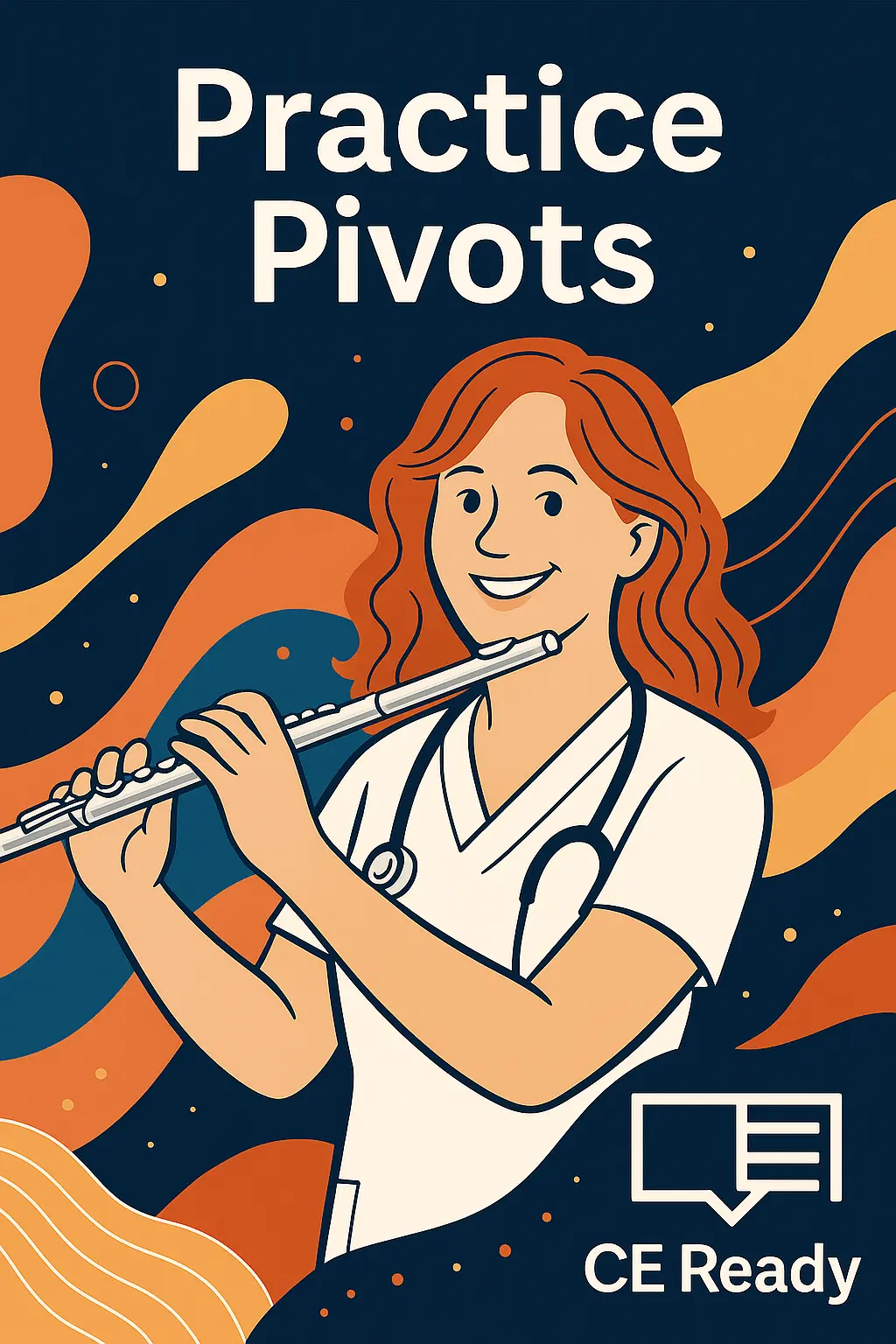
Authored by Dr. Pam Vollmer, DNP, RN, AMB-BC, NPD-BC, Accredited Provider Program Director for CE Ready
Some people know from the time they’re children that they’re meant to be nurses. Others arrive by accident, instinct, or a twist of fate. What’s remarkable about nursing is not just the entry point, but the many ways the profession allows you to evolve, to pivot, as you grow.
In today’s blog, I’m sharing my personal story and reflecting on why practice pivots are not only possible in nursing, but necessary for long-term professional fulfillment.
From Music to Nursing: A Surprising Shift
Growing up, I never imagined myself as a nurse. I was going to be a musician! That was the plan, the dream, even. I was fully immersed in music classes, rehearsals, and performances, confident that music would be my lifelong path.
But then something unexpected happened.
During college, I had what can only be described as an epiphany. On a whim, I changed my major from music to nursing. It was a bold shift, and I didn’t have all the answers, but something in me said, “This is where you need to go.”
That decision, spontaneous and surprising, would change the entire trajectory of my life.
Baptism by Fire in the Emergency Department
After graduating from nursing school, I wasn’t exactly sure where I fit. Like many new nurses, I felt both qualified and unprepared, confident in my skills but unsure of where they belonged.
By default, I was placed into an internship in the local Emergency Department. My very first day, we had two code blues and a level-1 trauma. I was instantly hooked.
The adrenaline, the urgency, the need for calm in the chaos, it clicked for me. I loved how quickly you had to think, how deeply you had to trust your team, and how no two days were the same.
For years, the ED was where I felt most alive as a nurse.
When the Fire Burns Too Hot
But as time went on, I noticed something unsettling.
The intensity that once thrilled me started to change who I was. I became calloused, more impatient, more cynical. I felt disconnected, not just from patients, but from myself.
And, I no longer recognized my own thoughts.
This wasn’t burnout in the traditional sense. It was more like a slow erosion of empathy, a quiet hardening. I realized the environment that had once brought out my best was now bringing out my worst.
And so, I pivoted again.
A New Calling: Veterans and Education
I transitioned to primary care, working with veterans, and eventually into nursing education. These new roles gave me the opportunity to reconnect with the reason I entered nursing in the first place: to help, to teach, and to make a difference.
With each pivot, I found new parts of myself.
I discovered that the fast pace of the ED wasn’t the only place to find meaning. Sometimes, slower conversations and sustained relationships provide a different kind of reward.
And as an educator, I’ve had the privilege of helping new nurses find their own path, and encouraging them to listen to that inner voice that says, “It’s time to change.”
Why Practice Pivots Matter: The Four Reasons Nurses Make Them
Over the years, I have listened to hundreds of nurses describe their own pivots. The stories are different, but the reasons behind them tend to cluster around four patterns:
Burnout and Preservation of Self
Some pivots are about survival. When a clinical environment consistently depletes more than it replenishes, leaving is not giving up. It is clinical wisdom applied to your own life. Recognizing the signs early and making a move before the damage becomes permanent is one of the most self-aware things a nurse can do.
Evolving Interests and Deepening Curiosity
What excited you in year two may not be enough in year twelve. Interests grow, deepen, and shift over the course of a career. A nurse who started in pediatrics may find a powerful calling in geriatric care. An RN who loved the OR may eventually want the long-game relationships of home health. Following that evolution is not inconsistency. It is growth.
Life Circumstances That Require Adjustment
Family needs, a partner’s relocation, a personal health challenge, aging parents, children starting school — life does not pause for nursing schedules. Pivots that respond to personal circumstances are valid, practical, and often temporary. Nursing is flexible enough to accommodate them, and that flexibility is one of the profession’s most underappreciated gifts.
Skill Development and New Challenge
Sometimes a pivot is simply about expanding. A nurse who has mastered one setting wants to test what else she can do. Certification programs, bridge programs, and specialty transitions all open new doors. And continuing education, chosen with intention, can help you step through them with confidence.
Common Career Pivots for Nurses: A Practical Reference
Here is a quick look at some of the most common nursing career pivots, what drives them, and what they typically lead to:
| Starting Point | Pivot Direction | What Often Drives It |
| Emergency Department RN | Primary care or outpatient clinic | Desire for work-life balance and longer patient relationships |
| Medical-Surgical RN | Home health or case management | More autonomy, one-on-one care, flexible schedule |
| LPN in long-term care | LPN-to-RN bridge program | Expanded scope, increased earning potential |
| Hospital-based RN | Nursing education or preceptor role | Passion for teaching, lower physical demands |
| Bedside RN | Nursing informatics or quality improvement | Systems thinking, interest in data and technology |
| NP in primary care | Private practice or telehealth | Greater autonomy and entrepreneurship |
| Any setting | Travel nursing or per diem work | Flexibility, variety, or life transition support |
Your pivot may be temporary or it may become your permanent next chapter. Both are valid. The goal is not to find the one right answer. It is to find the right answer for who you are right now.
Using Continuing Education to Support Your Pivot
Every meaningful career transition requires some form of preparation, and continuing education is one of the most accessible tools available to nurses who are navigating a change.
Think about it this way: if you are moving from bedside care into nursing leadership, CE courses in delegation, budgeting, and healthcare law give you a foundation before your first day in a management role. If you are transitioning into behavioral health, coursework in psychiatric nursing, trauma-informed care, and motivational interviewing makes you more effective from the start.
CE Ready offers a broad catalog of online continuing education courses designed for nurses at every career stage. Whether you are meeting your state renewal requirements in Florida or Georgia, or actively exploring CE aligned with a career transition, CE Ready makes it straightforward to learn with purpose.
Choose courses that connect to where you are going, not just where you are. That small shift in how you select your CE can make a meaningful difference over time.
A Reflection and an Invitation
Music was the first career I loved. Nursing became the one that shaped every version of who I am professionally. The Emergency Department cracked me open. Primary care with veterans deepened me. Nursing education gave me a way to keep giving without giving everything.
Every pivot left something with me that I still carry. The musician in me still shows up in how I teach, in the rhythm I try to bring to difficult conversations, in the belief that timing and listening are everything. Nothing you have done, learned, or loved is wasted. It is all part of who you become as a clinician.
So here is my invitation to you: if something in you is saying it is time to go somewhere new, take that seriously. Talk to nurses who have made the pivot you are considering. Look honestly at what the current environment is doing to you. And start choosing continuing education that points toward the next version of you, not just the one you have already become.
Wherever nursing takes you, your past experiences are assets, not footnotes. Bring them with you.
Frequently Asked Questions
Q: Is it normal to want to change nursing specialties?
A: Yes, completely. Changing nursing specialties or settings is common across all stages of a nursing career. Interests evolve, life circumstances change, and work environments affect wellbeing differently over time. The nursing profession is one of the most flexible in healthcare, and that flexibility is intended to be used. A specialty change is not a sign of failure. It is often a sign of professional self-awareness.
Q: How do I transition to a new nursing specialty?
A: Start by identifying the specialty and doing informational research, including talking to nurses already working in that area. Look into relevant certification programs, specialty CEUs, and any additional training that would strengthen your application. Some transitions happen through internal transfers within your current employer. Others require a job change. In either case, targeted continuing education can help you build credibility and confidence before you make the formal move.
Q: Can continuing education help me change nursing careers?
A: Yes. Continuing education is one of the most practical tools for a nurse navigating a career transition. Coursework in your target specialty builds knowledge before you start, demonstrates commitment to potential employers, and in some cases contributes toward specialty certification. Choosing CEUs that align with your next career direction, rather than the minimum required for renewal, is a strategic investment in your professional future.
Q: What should I do if I am experiencing nursing burnout?
A: Burnout in nursing is serious and deserves a real response. If you are experiencing emotional exhaustion, compassion fatigue, or a growing sense of cynicism about your work, start by talking with a trusted colleague, mentor, or mental health professional. Consider whether a change in specialty, setting, or work schedule might help. The American Nurses Association offers resources on nurse wellbeing and healthy work environments. A career pivot is sometimes the right long-term answer, but short-term support matters too.
Q: Do I have to go back to school for a nursing career change?
A: Not always. Many specialty transitions, including moves into home health, case management, long-term care, outpatient settings, and informatics, can be accomplished with targeted CE, employer-sponsored training, and specialty certifications rather than a full academic degree. A return to school is required for advanced practice roles such as NP, CRNA, CNS, or CNM. For other transitions, a thoughtful CE plan and a willingness to learn are often enough to get started.
References
American Nurses Association. Nursing: Scope and Standards of Practice. Nursingworld.org.
Bureau of Labor Statistics. Registered Nurses — Occupational Outlook Handbook. U.S. Department of Labor.