Mandatory Continuing Education Topics Nurses Often Overlook
Back to Blog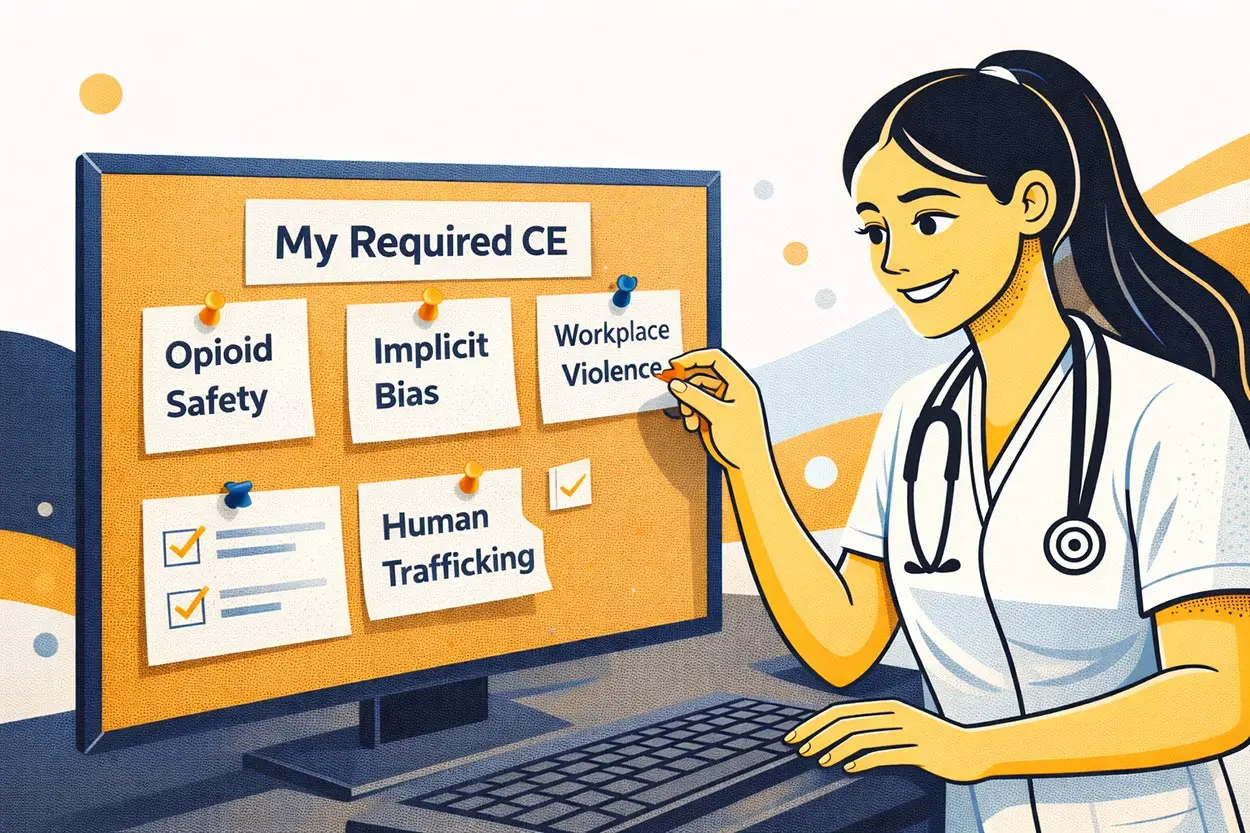
Reviewed by Dr. Pam Vollmer, DNP, RN, AMB-BC, NPD-BC, Accredited Provider Program Director for CE Ready
What nurses need to know
Mandatory nursing continuing education topics are specific subject areas required by state boards of nursing that must be completed for license renewal. These topic specific requirements are designed to address patient safety risks, legal responsibilities, and public health priorities.
Mandatory CE topics vary by state, but patterns exist nationwide. Ethics or jurisprudence education, abuse recognition, patient safety and substance use related education are commonly required across multiple jurisdictions. Guidance from the National Council of State Boards of Nursing emphasizes continuing competence as a regulatory responsibility tied directly to public protection (https://www.ncsbn.org/nursing-regulation/continuing-competence.page).
Mandatory topics may only be required once per renewal cycle or once per license period, making them easier to forget than annual or biennial hour totals. Some states require topic specific education only under certain conditions, such as prescriptive authority or first time renewal. In addition, mandatory topics are sometimes embedded within broader course titles, making it unclear whether a course satisfies a specific requirement.
Missing a required CE topic can have significant consequences. State boards of nursing frequently use post renewal audits to verify compliance. Failure to produce documentation for a required topic may result in fines, delayed renewal, or additional corrective education.
Many required topics align with high risk areas of practice, such as ethical decision making, recognition of abuse, and patient safety. National guidance from organizations such as the American Nurses Association and the U.S. Department of Health and Human Services reinforces the importance of education in these areas.
Why Mandatory CE Topics Are Often Missed
Mandatory continuing education topics are frequently overlooked because topic specific rules are layered on top of broader hour based expectations. Most renewal systems emphasize total contact hours, which can unintentionally shift attention away from required content areas.
One common reason mandatory topics are missed is variability in how requirements are structured. Some states require certain topics only once per renewal cycle or only under specific conditions such as first-time renewal. These nuances make it easy to assume a requirement has already been met. Guidance from the National Council of State Boards of Nursing highlights continuing competence as an ongoing obligation that includes both hours and content, reinforcing that topic specific requirements are not optional add ons.
Course naming and packaging also contribute to confusion. Mandatory topics may be embedded within broader courses without being clearly labeled, leaving nurses unsure whether a specific requirement has been satisfied. In other cases, courses address a topic generally but do not meet a state’s defined criteria for required education, such as minimum contact hours or approved provider status.
Another factor is reliance on past renewal experience. Nurses who have renewed licenses for many years may assume requirements remain unchanged from cycle to cycle. However, mandatory topics are often added or updated in response to legislative action, public health priorities, or emerging risks.
Time pressure near renewal deadlines further increases the likelihood of missed topics. When continuing education is completed late in the cycle, course selection often prioritizes speed and convenience. This approach increases the risk of completing education that meets hour totals but fails to satisfy one or more mandatory topics.
Commonly Overlooked Mandatory CE Topics
Ethics and jurisprudence education is one commonly overlooked requirement. These courses are sometimes required only once per renewal cycle or once per license period, making them easier to forget. Ethical guidance from the American Nurses Association underscores the role of ongoing ethics education in supporting professional accountability and patient advocacy.
Human trafficking education is another requirement that is frequently missed. In response to public safety priorities, many states require nurses to complete education on recognizing and responding to human trafficking. These requirements are sometimes embedded within broader abuse or violence prevention categories, leading to confusion. Federal guidance from the Administration for Children and Families Office on Trafficking in Persons highlights the healthcare professional’s role in identification and response, reinforcing why this topic is mandated in many jurisdictions.
Abuse recognition education is also commonly required and often overlooked. These courses are designed to improve early identification and appropriate reporting of abuse, which are critical patient safety responsibilities. Public health resources from the Centers for Disease Control and Prevention emphasize the role of healthcare professionals in prevention and early intervention for violence and abuse related harm.
Substance use and mental health related education is another area where mandatory requirements may be missed. Some states require education related to substance use disorders, impaired practice, or mental health awareness. National resources from the Substance Abuse and Mental Health Services Administration highlight the importance of education in recognizing substance use.
Patient safety focused topics may also be mandated, including education related to error prevention, quality improvement, or safety culture. National quality initiatives promoted by the Agency for Healthcare Research and Quality reinforce why patient safety education is frequently included in mandatory CE requirements.
How Missed CE Topics Impact License Renewal and Audits
Missing a mandatory continuing education topic can have consequences that extend beyond a delayed renewal. State boards of nursing view topic specific CE requirements as essential components of public protection.
In many states, license renewal relies on attestation rather than submission of certificates at the time of renewal. This process places responsibility on the nurse to accurately confirm that all required topics were completed. If a mandatory topic was missed, the issue may not be identified until a post renewal audit occurs. Guidance from the National Council of State Boards of Nursing emphasizes that boards of nursing are charged with protecting the public through regulation, which includes verifying continuing competence and compliance with renewal requirements.
During an audit, boards typically request documentation demonstrating completion of required continuing education within the applicable renewal period. When a mandatory topic is missing, the nurse may be required to complete corrective education, pay fines, or face disciplinary action depending on the state and circumstances. In some cases, renewal may be delayed or a license may be placed on hold until compliance is restored.
Missed mandatory topics can also create professional risk beyond regulatory consequences. Education related to ethics, abuse recognition, substance use, patient safety, and human trafficking is required because these areas are associated with higher risk for patient harm, legal exposure, or ethical violations. National guidance from organizations such as the American Nurses Association reinforces the importance of maintaining competence in these domains as part of professional accountability and ethical practice.
Strategies to Ensure All Mandatory CE Requirements Are Met
Preventing missed mandatory continuing education topics requires a proactive and organized approach to CE planning. Because topic specific requirements carry the same regulatory weight as total contact hours, strategies that prioritize early review and intentional course selection are most effective.
- Begin each renewal cycle by reviewing current requirements directly from the state board of nursing. Mandatory CE topics are added or revised in response to legislative changes, public health priorities, and emerging risks, and requirements may differ from one renewal period to the next.
- Create a checklist that separates mandatory topics from general contact hour requirements. Listing required content areas such as ethics, abuse recognition, human trafficking, substance use, or patient safety helps ensure these topics are addressed intentionally rather than assumed to be covered incidentally.
- Select courses that clearly identify mandated topics in the course title or description. Courses that explicitly state they meet a specific requirement reduce ambiguity during audits and simplify documentation review.
- Complete mandatory topic courses early in the renewal cycle. Addressing these requirements first reduces last minute pressure and allows flexibility later when selecting additional education based on practice interests or professional development goals.
- Maintain organized documentation throughout the renewal period. Save certificates immediately after course completion and confirm that required information such as provider name, completion date, contact hours, and topic designation is included. Even in states that use electronic tracking systems, retaining certificates supports audit readiness and provides backup verification if discrepancies arise.
Using a centralized continuing education provider can further reduce the risk of missed requirements. Platforms that organize courses by mandatory topics, track completed education, and provide standardized documentation help streamline compliance. CE Ready offers mandatory nursing continuing education courses organized by state requirements designed to support accurate completion and audit readiness across jurisdictions.
References
Agency for Healthcare Research and Quality. Patient safety culture, training, and quality improvement resources.
https://www.ahrq.gov/patient-safety
American Nurses Association. Code of Ethics for Nurses with Interpretive Statements.
https://www.nursingworld.org/coe-view-only
Centers for Disease Control and Prevention. Violence prevention, abuse recognition, and public health resources.
https://www.cdc.gov/violenceprevention
CE Ready. Mandatory nursing continuing education and licensure compliance resources.
https://ceready.com
National Council of State Boards of Nursing. Nursing regulation and public protection overview.
https://www.ncsbn.org/nursing-regulation.page
Substance Abuse and Mental Health Services Administration. Behavioral health, substance use, and prevention resources.
https://www.samhsa.gov
U.S. Department of Health and Human Services, Administration for Children and Families. Office on Trafficking in Persons.
https://acf.gov/otip