How Nurses Can Organize CE Credits for Renewal
Back to Blog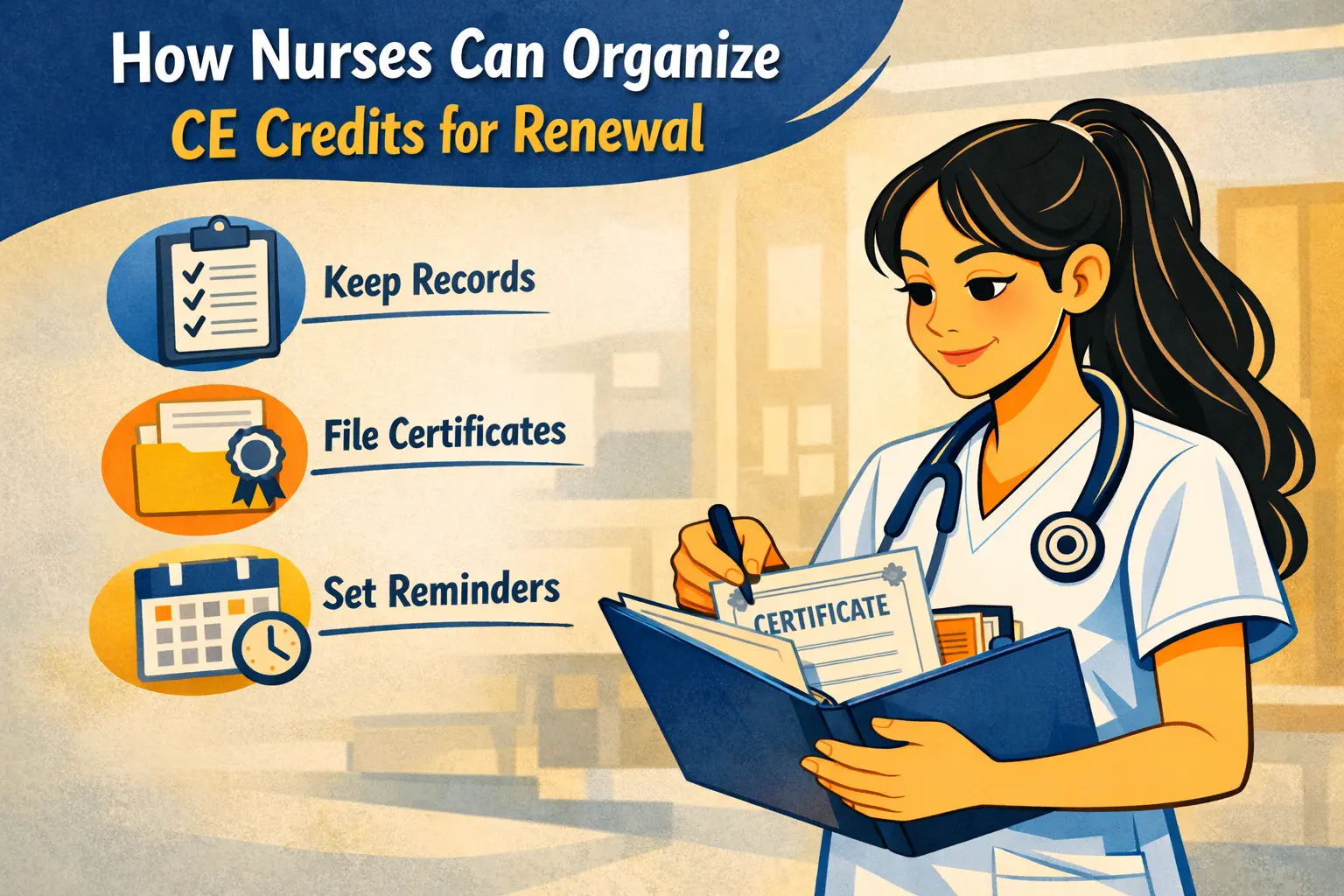
Authored by Dr. Pam Vollmer, DNP, RN, AMB-BC, NPD-BC, CEO and Director of Content at CE Ready
What Nurses Need to Know
Organizing continuing education records is one of the easiest ways to make license renewal less stressful. Completing courses is only part of the process. You also need to know what your board requires, save proof of completion, and make sure your records are easy to find when renewal time comes. Because renewal rules vary by state, it is important to verify requirements with your own board using state-specific licensure guidance from NCSBN.
Many nurses do not struggle with completing CE. They struggle with tracking it. Certificates get scattered across email folders, employer portals, and multiple learning platforms. That is why it helps to review CE requirements for nurses across the United States early in the renewal cycle and build a plan based on your state’s current requirements.
Here is where CE Ready offers a meaningful advantage. CE Ready is an ANCC-accredited provider (provider number P0986) that maintains completed certificates so your records stay easy to find in one place instead of hunting through old emails or multiple websites. The CE Ready Knowledge Base also has practical support for nurses with account or documentation questions.
Why CE Organization Matters for License Renewal
CE organization matters because renewal is not only about earning hours. It is also about documenting those hours clearly and accurately. You may complete all your required CE and still feel rushed at renewal time if certificates are hard to find or records are incomplete.
A clear system helps you track course titles, providers, dates, contact hours, and any required subject areas. It also helps prevent mistakes such as counting the wrong course, missing a required topic, or realizing too late that a certificate was never saved. Nurses who want a clearer picture of renewal expectations can start with CE requirements nurses must meet for license renewal and then narrow their plan by state using the CE Ready states page.
Good organization also lowers stress during audits or renewal reviews. Some boards may request proof of completion, and certifying bodies may also expect records to support renewal activities. Nurses who hold ANCC credentials should review ANCC Nursing Certification Renewal guidance so their documentation system works for both licensure and certification requirements.
Because CE Ready keeps completed certificates accessible, it can also function as part of a nurse’s long-term record-keeping strategy. That is especially helpful for busy nurses who want renewal records to stay easy to find over time.
How to Track CE Credits Throughout the Renewal Cycle
The easiest way to track nursing CE credits is to use one consistent system throughout the renewal cycle. It does not need to be complicated. It only needs to be consistent.
A practical method is to use one digital folder and one running log. The folder stores certificates. The log tracks the details for each course completed. Here is what to record for each activity:
- Course title
- Provider name
- Completion date
- Contact hours awarded
- Required topic area if applicable
- Renewal cycle the course applies to
Saving documentation immediately after each course is completed is the single most effective habit you can build. Waiting until the end of the year makes it much more likely that something will be missed or misplaced.
Nurses comparing providers can browse CE Ready’s course catalog to find ANCC-accredited options organized by state and specialty. CE Ready also handles CE Broker reporting in participating states, which can make documentation easier for nurses in those jurisdictions. For broader guidance on building a CE routine that works with a busy schedule, CE planning strategies for nurses working multiple jobs is worth bookmarking.
What to Save After Every CE Course
Every completed CE course should come with documentation you can actually use if your board asks for proof later. At a minimum, each CE record should include:
- Certificate of completion
- Your full name as it appears on your license
- Course title
- Provider name and address
- Completion date
- Number of contact hours awarded
- Accreditation or approval statement
ANCC documentation guidance supports all of those elements as part of a complete completion record. A vague or incomplete certificate is much harder to use if your board requests proof later.
It can also be helpful to save the course description, a receipt or confirmation email, and a note about whether the course meets a required topic area. This becomes especially important when you are tracking both license renewal and certification renewal at the same time.
The simplest habit is to download the certificate right away, rename the file clearly with the course title and completion date, and place it in your renewal folder. Nurses using CE Ready have an added advantage because completed certificates remain accessible for life, making it easier to keep all records in one organized place.
How Long Nurses Should Keep CE Records
There is no single national rule for how long nurses should keep CE records. Retention periods vary by state board of nursing, by certification body, and sometimes by the type of credential being renewed.
The safest approach is to confirm the requirement with your own board of nursing, and when relevant, review ANCC certification renewal guidance for credential-specific timelines. In practice, many nurses find it easier to keep records longer than the minimum required period. Digital storage makes that simple, and longer retention provides peace of mind if questions come up well after renewal.
Here is a general starting point based on common patterns:
| Credential Type | Common Retention Guidance |
| RN or LPN license renewal | Often 2 to 5 years depending on state |
| APRN license renewal | Verify with your state board — may differ from RN rules |
| ANCC certification renewal | Check ANCC guidance for your specific credential |
| Mandatory topic CE | Some states require longer retention for specific topics |
This table reflects common patterns, not a universal rule. Always verify with your own board or certifying body before deciding how long to keep your records.
How to Prepare for a Nursing CE Audit
The best way to prepare for a CE audit is to stay organized before renewal begins. Waiting until an audit request arrives creates unnecessary stress and leaves very little time to track down missing records.
A solid pre-audit routine includes several straightforward steps. Check completed hours against current renewal requirements. Make sure each certificate is easy to find and clearly labeled. Confirm that course details are complete and accurate. Review required subject areas to make sure all mandatory topics are covered. Verify that records match the correct renewal cycle.
Nurses who need a refresher on state variation can review continuing education requirements for nurses across the United States or check the NCSBN nurse licensure guidance tool for state-specific rules.
Pre-Audit Checklist
- Confirm total hours completed match your state’s requirement
- Verify mandatory topics are covered if your state requires them
- Check that each certificate includes your name, course title, provider, completion date, contact hours, and approval language
- Make sure records are saved and clearly labeled
- Confirm records belong to the correct renewal cycle
- Check your state board’s record-retention rule and follow it
CE Ready makes audit preparation easier because completed certificates remain accessible in one place. Nurses who prefer an all-in-one approach may also want to explore whether unlimited nursing CE is worth it for license renewal as part of their planning.
Tools and Strategies for Organizing CE Documentation
The best organizational tools are often the simplest ones. Most nurses do not need specialized software. They need a system they will actually use consistently throughout the renewal cycle.
Helpful options include:
- One digital folder per renewal cycle, clearly labeled by year
- A simple spreadsheet or tracker for completed hours and topics
- Calendar reminders for quarterly CE check-ins
- Consistent file naming for every certificate, such as CourseTitle-CompletionDate
- A cloud backup for important records
Some nurses still prefer a physical binder, especially for hard copies. That can work well, but a digital backup is always a smart addition. Paper records are harder to search and easier to misplace during a busy period.
Choosing a CE provider that keeps records organized on your behalf can also make a meaningful difference. CE Ready maintains completed certificates for life, which means you always have one reliable place to return to whenever renewal or documentation questions come up. Nurses who want to compare providers before choosing can review how nurses can choose high-quality continuing education and then browse CE Ready courses when ready to enroll.
Common CE Organization Mistakes to Avoid
Most documentation problems at renewal time are completely avoidable. Here are the ones that come up most often.
Assuming finishing the course is the end of the task. It is not. The certificate still needs to be saved, labeled, and filed. A completed course with no saved record is much harder to prove during an audit.
Waiting too long to organize records. Nurses often plan to clean everything up closer to renewal, but that creates missing files, confusion about hours, and unnecessary stress during an already busy time.
Mixing different types of education together without tracking them separately. License renewal CE, certification renewal activities, employer training, and academic coursework may not all count the same way. A clear system keeps these categories separate and prevents counting the wrong activities toward the wrong requirement.
Overlooking required topics. Nurses who want to avoid that issue should review mandatory continuing education topics nurses often overlook, especially if their state includes topic-specific renewal rules.
Underestimating how useful long-term certificate access can be. Records that disappear over time make renewal harder every cycle. CE Ready helps solve that problem by maintaining completed certificates for life.
A Simple CE Organization System to Start Today
You do not need a complicated system to stay organized. Here is a five-step approach that works for most nurses:
- Check current renewal requirements using your board of nursing or the NCSBN licensure guidance tool.
- Create one folder for the current renewal cycle and label it clearly.
- Save each certificate immediately after course completion with a clear file name.
- Update a simple running log with the key details for every course.
- Review your folder and log every few months instead of waiting until renewal is close.
For nurses using CE Ready, this system becomes even simpler. Completed certificates are maintained for life, which means your records stay easy to find in one reliable place. Nurses who are ready to match courses to their state can find approved nursing CE courses by state or explore the full CE Ready course catalog.
Frequently Asked Questions
Why is CE organization important for license renewal?
Completing CE is only part of the renewal process. You also need to save proof of completion, track required topics, and make sure records are easy to find if your board requests them. Good organization reduces renewal stress and helps nurses stay audit-ready throughout the cycle.
What information should be on a CE certificate?
A strong CE certificate should include your name, course title, provider name and address, completion date, contact hours awarded, and the accreditation or approval statement. ANCC documentation guidance supports all of these elements as part of a complete completion record.
How long should nurses keep CE records?
Retention periods vary by state board and certification body. The safest approach is to confirm the requirement with your own board and keep records at least as long as required — and often longer. Many nurses find it easier to keep everything digitally since storage is simple and retrieval is fast.
What is the best way to track CE credits?
The most effective system is one you will actually use consistently. One digital folder per renewal cycle, a simple running log of completed courses, and a habit of saving certificates immediately after completion covers most of what nurses need. Quarterly check-ins help you stay on track without last-minute scrambling.
How do I prepare for a CE audit?
Start by confirming your completed hours match your state’s requirement. Check that all mandatory topics are covered. Make sure each certificate includes the required details. Verify records belong to the correct renewal cycle and follow your state’s record-retention rule. The CE Ready Knowledge Base has additional guidance on documentation and audit readiness.
What CE organization mistakes should nurses avoid?
The most common mistakes are not saving certificates right away, waiting until renewal to organize records, mixing different types of CE without tracking them separately, and overlooking required topic areas. A consistent system built early in the renewal cycle prevents most of these problems.
How can CE Ready help nurses organize CE credits?
CE Ready maintains completed certificates for life, which means your records stay accessible in one place whenever renewal or audit questions come up. Nurses can browse the CE Ready course catalog to find accredited options by state and use the CE Ready Knowledge Base for support with documentation and account questions.
References
American Nurses Credentialing Center. (n.d.). Frequently asked questions: Nursing continuing professional development accreditation. American Nurses Association. https://www.nursingworld.org/organizational-programs/accreditation/ncpd/faqs/
American Nurses Credentialing Center. (n.d.). ANCC certification renewal requirements. https://www.nursingworld.org/certification/renewals/
National Council of State Boards of Nursing. (n.d.). Nurse licensure guidance. https://www.ncsbn.org/nursing-regulation/licensure/nurse-licensure-guidance.page