Evidence Based CE Topics Every Nurse Should Prioritize
Back to Blog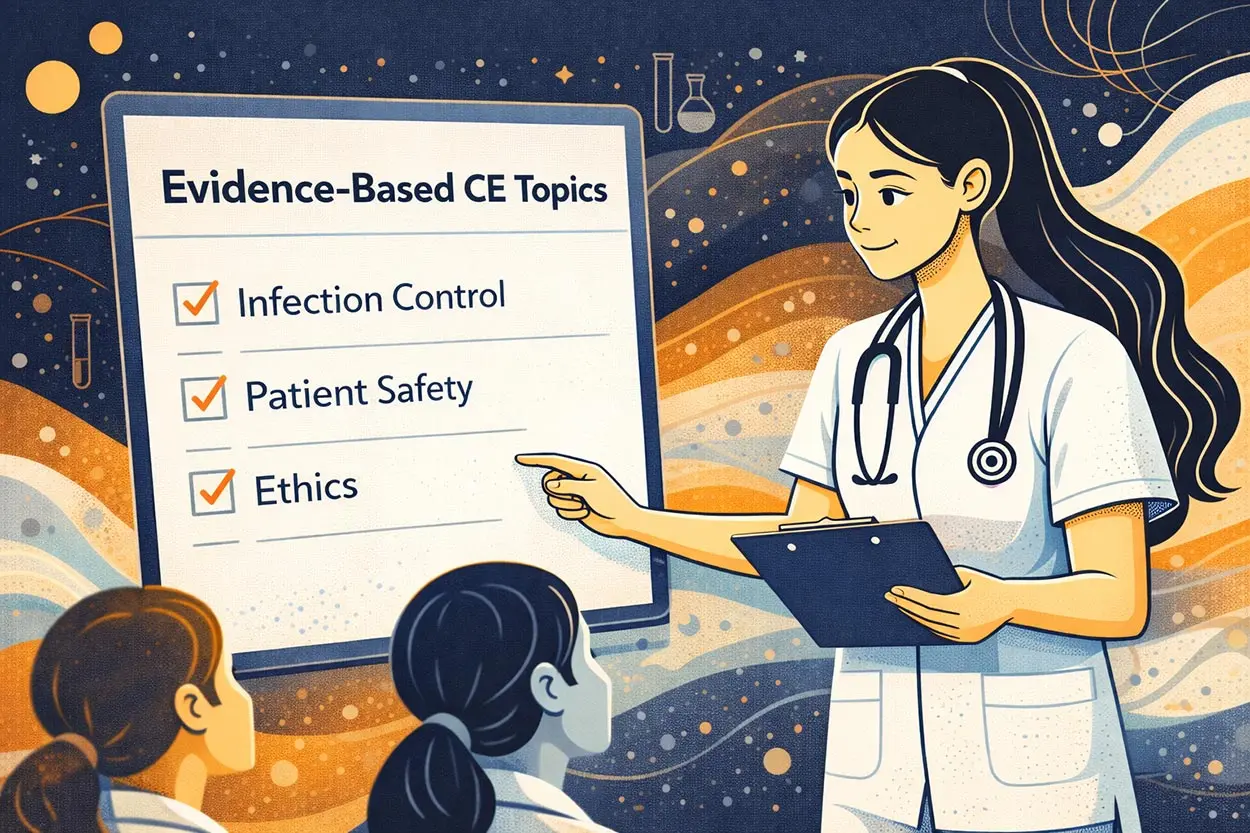
Reviewed by Dr. Pam Vollmer, DNP, RN, AMB-BC, NPD-BC, Accredited Provider Program Director for CE Ready
What nurses need to know
Evidence based nursing continuing education refers to learning activities grounded in current research, clinical guidelines, and consensus standards that support safe and effective nursing practice. For licensed practical nurses, registered nurses, and advanced practice registered nurses, prioritizing evidence based CE helps bridge the gap between regulatory requirements and real world clinical practice.
Continuing education serves multiple purposes in nursing. It supports license renewal, reinforces professional accountability, and helps nurses maintain competence as healthcare evolves. However, not all continuing education has an equal impact. Courses that reflect outdated practices, lack credible sourcing, or focus solely on meeting minimum hour requirements may do little to improve patient outcomes or clinical confidence. Evidence based CE prioritizes content that reflects current standards, emerging risks, and high impact areas of nursing care.
Certain topic areas consistently demonstrate strong relevance across practice settings. Patient safety, ethics, pain management, infection prevention, and mental health represent core domains where updated knowledge directly influences care quality, risk reduction, and professional decision making. These topics align with national priorities established by organizations such as the Centers for Disease Control and Prevention, the Agency for Healthcare Research and Quality, and the American Nurses Association, all of which emphasize ongoing education as a foundation of safe nursing practice.
Focusing continuing education efforts on evidence based topics also supports compliance across state lines. Many state boards of nursing mandate education in areas such as patient safety, ethics, and substance use or pain management. Selecting high quality CE in these domains allows nurses to meet licensure requirements while strengthening clinical practice.
Why Evidence Based Continuing Education Matters in Nursing Practice
Evidence based continuing education plays a critical role in maintaining safe, consistent, and high quality nursing care. As clinical guidelines evolve, continuing education grounded in current evidence helps ensure that nursing practice reflects the best available knowledge.
Healthcare environments are increasingly complex. Advances in technology, changing patient populations, and evolving treatment standards require nurses to regularly update their clinical knowledge. Evidence based continuing education draws from peer reviewed research, national guidelines, and expert consensus. This approach helps reduce variation in care and supports more predictable patient outcomes.
Patient safety is a central driver of evidence based education. Many adverse events are linked to system failures, communication breakdowns, or gaps in knowledge rather than isolated individual errors. Continuing education that emphasizes safety science, error prevention, and risk reduction aligns with national safety priorities promoted by organizations such as the Agency for Healthcare Research and Quality and the Centers for Disease Control and Prevention.
Ethical practice and professional accountability also depend on current knowledge. Regulatory expectations, scope of practice considerations, and ethical challenges evolve alongside healthcare delivery models. Evidence based education helps nurses navigate complex clinical situations, apply ethical frameworks consistently, and understand regulatory responsibilities within their roles. Professional guidance from organizations such as the American Nurses Association reinforces the importance of ongoing education in supporting ethical nursing practice.
Evidence based continuing education also supports regulatory compliance. Many state boards of nursing require education in specific high risk or high impact areas, including patient safety, pain management, infection prevention, and mental health. Courses grounded in current evidence are more likely to meet both licensure requirements and practice needs, reducing the need to complete redundant or low value education.
Patient Safety Focused CE Topics
Patient safety remains a foundational priority across all nursing roles and practice settings. Continuing education focused on patient safety equips nurses with updated strategies to reduce preventable harm, recognize system vulnerabilities, and respond effectively to safety risks that commonly arise in clinical care.
Evidence based patient safety education often addresses topics related to medication safety, communication and handoff practices, error prevention, and recognition of early warning signs of clinical deterioration. These areas are consistently identified in national safety initiatives because breakdowns in these processes contribute significantly to adverse events. Educational guidance from the Agency for Healthcare Research and Quality emphasizes systems based approaches to safety, including teamwork, standardized processes, and use of evidence informed tools to reduce risk.
Medication safety is a particularly high impact focus for continuing education. Courses addressing safe medication administration, high alert medications, dosing errors, and look alike or sound alike drugs help nurses strengthen vigilance and reduce medication related harm. Ongoing education in this area supports safe practice across inpatient, outpatient, and community settings and aligns with patient safety priorities highlighted by the Centers for Disease Control and Prevention.
Communication related safety topics are also essential. Education that addresses effective handoffs, documentation accuracy, and closed loop communication supports continuity of care and reduces the risk of missed or delayed interventions. These skills are especially relevant in fast paced environments, during transitions of care, and in interdisciplinary settings where miscommunication can have serious consequences.
Patient safety focused continuing education frequently includes content related to fall prevention, pressure injury prevention, and safe use of medical devices. These topics reflect common sources of patient harm and are applicable across specialties and levels of care. Evidence based strategies in these areas emphasize risk assessment, early intervention, and consistent application of preventive measures.
Ethics and Professional Responsibility CE Topics
Ethical decision making and professional responsibility are central to nursing practice and require ongoing reflection as healthcare systems, patient populations, and regulatory expectations evolve. Continuing education focused on ethics helps nurses apply professional standards consistently.
Evidence based ethics education commonly addresses principles such as autonomy, beneficence, non-maleficence, justice, and fidelity. These principles guide everyday nursing decisions related to informed consent, patient advocacy, confidentiality, and respect for patient preferences. As care settings become more complex, nurses are increasingly asked to balance ethical obligations with institutional policies, resource limitations, and interdisciplinary dynamics.
Professional accountability is another key focus of ethics related continuing education. Courses that explore scope of practice, delegation, documentation standards, and legal responsibilities support safe and compliant practice. Regulatory expectations are shaped by state boards of nursing and reinforced through professional standards. The American Nurses Association provides guidance on ethical nursing practice and the Code of Ethics, which serves as a foundational reference for professional conduct across roles and settings (https://www.nursingworld.org).
Ethical lapses, such as failure to report concerns, incomplete documentation, or breakdowns in professional boundaries, can contribute to patient harm. Evidence based CE that addresses ethical challenges encourages reflective practice and supports a culture of safety, transparency, and accountability.
Emerging ethical considerations further highlight the importance of ongoing education. Topics such as end of life decision making, use of technology in care delivery, privacy in digital health records, and equity in access to care require nurses to apply ethical principles in new and evolving contexts. Continuing education grounded in current guidance helps nurses respond thoughtfully to these challenges while maintaining professional integrity.
Pain Management and Safe Prescribing Education
Pain management remains a critical and evolving area of nursing practice, requiring a balance between effective symptom relief, patient safety, and responsible medication use. Evidence based continuing education in pain management supports nurses in applying current standards and recognizing risks.
High quality pain management education emphasizes comprehensive pain assessment, including physical, psychological, and functional components. Evidence based approaches recognize that pain is subjective and influenced by multiple factors. Education grounded in current guidelines helps nurses distinguish between acute, chronic, and neuropathic pain and apply appropriate interventions for each.
Safe prescribing and medication related education is especially important given the ongoing impact of the opioid crisis. Continuing education that addresses opioid stewardship, non opioid alternatives, and risk mitigation strategies supports safer pain management practices. National guidance from the Centers for Disease Control and Prevention highlights the importance of using the lowest effective dose, monitoring for adverse effects, and integrating nonpharmacologic therapies when appropriate (https://www.cdc.gov).
For advanced practice registered nurses and nurses involved in medication management, evidence based CE often includes content on pharmacology, controlled substance regulations, and patient education related to medication use. Understanding indications, contraindications, drug interactions, and monitoring parameters supports safer prescribing and administration practices while reducing the risk of medication related harm.
Pain management education also increasingly incorporates nonpharmacologic strategies such as physical modalities, cognitive behavioral approaches, and integrative therapies. Evidence supports the use of multimodal pain management plans that address pain while minimizing reliance on high risk medications. Continuing education that reflects this shift helps nurses contribute meaningfully to comprehensive pain care plans.
Infection Prevention and Control Education
Infection prevention and control remains a core responsibility across all nursing roles and practice settings. Evidence based continuing education in this area supports consistent application of practices that reduce healthcare associated infections and protect both patients and healthcare personnel.
High quality infection prevention education emphasizes foundational principles such as hand hygiene, use of personal protective equipment, and environmental cleaning. These practices are supported by extensive research and remain among the most effective strategies for preventing transmission of infectious agents. Guidance from the Centers for Disease Control and Prevention outlines evidence based recommendations for standard and transmission based precautions that apply across care environments (https://www.cdc.gov).
Continuing education also addresses recognition and management of emerging and re emerging infectious threats. Nurses play a key role in early identification of infection, isolation precautions, and adherence to reporting requirements. Education grounded in current public health guidance helps ensure that infection prevention practices remain responsive to evolving risks.
Device related and procedure related infection prevention is another important focus. Education addressing care of central lines, urinary catheters, surgical sites, and respiratory equipment supports reduction of common sources of healthcare associated infections. Evidence based bundles and standardized protocols, which are promoted through national quality initiatives, reinforce the importance of consistent practice in these high risk areas.
Infection prevention education also includes antimicrobial stewardship principles. Understanding appropriate antibiotic use, resistance patterns, and the nurse’s role in monitoring therapy supports broader efforts to reduce antimicrobial resistance. National and global organizations emphasize education as a key component of stewardship programs.
Mental Health and Behavioral Health Education
Mental health and behavioral health concerns affect patients across all care settings. Nurses frequently encounter patients with anxiety, depression, substance use disorders, trauma related conditions, and cognitive or behavioral changes. Education grounded in current evidence supports earlier recognition, appropriate response, and safer patient interactions.
Evidence based mental health education emphasizes recognition of common mental health conditions and their impact on physical health, treatment adherence, and recovery. Courses that address screening, assessment, and therapeutic communication help nurses identify symptoms that may otherwise be overlooked in busy clinical environments. National guidance from the Centers for Disease Control and Prevention highlights the growing prevalence of mental health conditions and the importance of integrating mental health awareness across healthcare settings (https://www.cdc.gov).
Crisis recognition and response is another essential focus area. Education related to suicide risk assessment, de escalation techniques, and management of acute behavioral distress supports patient and staff safety. Evidence based approaches emphasize early identification of warning signs, use of validated screening tools, and collaboration with interdisciplinary teams when higher levels of support are needed.
Trauma informed care is increasingly recognized as a best practice in mental and behavioral health education. Understanding how trauma influences behavior, communication, and healthcare engagement helps nurses provide care that reduces re-traumatization and builds trust. Evidence based trauma informed frameworks are promoted by national and international organizations as part of patient centered, equitable care delivery.
Mental health education also intersects with substance use and pain management. Continuing education that addresses co-occurring mental health and substance use conditions supports more comprehensive assessment and safer care planning. This integration aligns with public health priorities and reinforces the nurse’s role in supporting both physical and psychological well being.
How to Choose High Quality Evidence Based CE
Selecting high quality evidence based continuing education requires more than identifying courses that meet licensure hour requirements. The value of continuing education is closely tied to the quality of its sources, the relevance of its content, and how well it aligns with current standards of nursing practice.
One of the most important indicators of evidence based CE is the use of credible, up to date sources. High quality courses clearly reference current clinical guidelines, peer reviewed research, and recommendations from recognized organizations such as the Centers for Disease Control and Prevention, the Agency for Healthcare Research and Quality, and professional nursing associations. Education that lacks transparent sourcing or relies on outdated references may not reflect current best practices.
Relevance to clinical practice is another key factor. Evidence based CE should address real world clinical scenarios, common risks, and decision making challenges nurses encounter in practice. Courses focused on patient safety, ethics, pain management, infection prevention, and mental health tend to have broad applicability across settings and roles. Selecting education that connects evidence to practical application supports meaningful learning rather than passive content consumption.
Accreditation and provider credibility also matter. Continuing education offered by accredited providers that meet state board standards is more likely to be accepted for licensure renewal and withstand audit review. Clear designation of contact hours, learning objectives, and completion criteria supports both compliance and learning outcomes.
Providers that offer standardized certificates, completion tracking, and organized records simplify licensure renewal and audit preparation. CE Ready offers evidence based nursing continuing education aligned with current clinical guidance while providing clear documentation that supports licensure compliance across states.
Finally, intentional selection of continuing education topics supports long term professional development.
References
Agency for Healthcare Research and Quality. Patient safety and quality improvement resources.
https://www.ahrq.gov
American Nurses Association. Nursing ethics, professional standards, and continuing education guidance.
https://www.nursingworld.org
Centers for Disease Control and Prevention. Patient safety, infection prevention, pain management, and mental health resources.
https://www.cdc.gov
World Health Organization. Infection prevention, patient safety, and mental health guidance.
https://www.who.int