Mandatory CE Courses Nurses Need for License Renewal
Back to Blog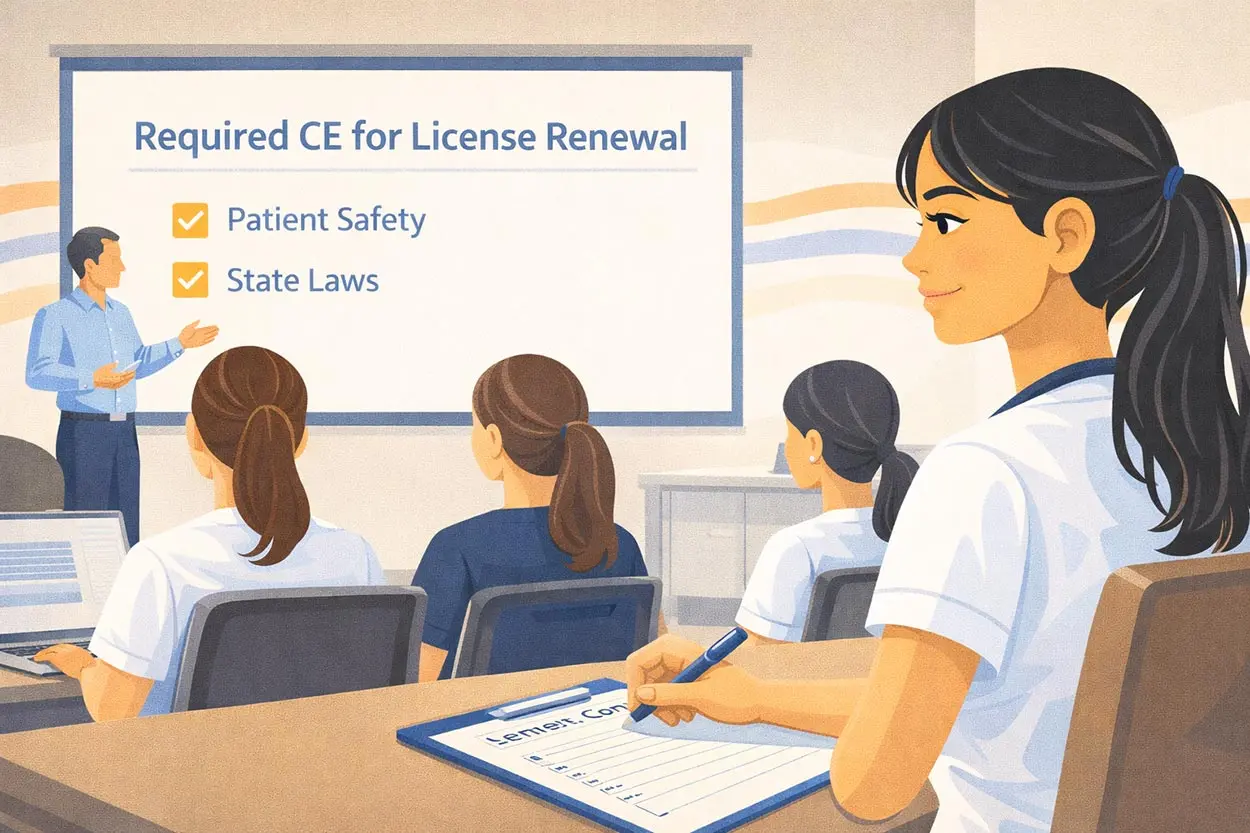
Reviewed by Dr. Pam Vollmer, DNP, RN, AMB-BC, NPD-BC, Accredited Provider Program Director for CE Ready
What nurses need to know
Mandatory CE for nurses is required continuing education topics that must be completed for license renewal. Mandatory CE courses are required by state boards of nursing and cannot be replaced with elective continuing education. These requirements are established by state boards of nursing and are separate from the total number of contact hours required. Missing a required course can place a license out of compliance, even when all other CE hours have been completed.
Mandatory CE courses are typically tied to public safety, professional accountability, or state specific regulatory priorities. Common examples include patient safety, ethics, nursing laws and rules, prevention of medical errors, domestic violence, or human trafficking education. While many of these topics are familiar, the exact requirements vary significantly by state and by license type.
State boards of nursing determine which CE topics are mandatory and how often they must be completed. Guidance from the National Council of State Boards of Nursing emphasizes that continuing competence requirements are designed to protect the public and ensure safe nursing practice, but implementation is handled at the state level.
This state level variability is where many nurses encounter problems. Requirements may change between renewal cycles, differ by role, or apply only under certain conditions such as first time renewal or practice setting. Relying on past experience or assumptions from another state can result in missing a required course.
Understanding what counts as mandatory CE, how requirements differ across states, and where to verify current expectations helps nurses plan continuing education more effectively. This blog outlines common mandatory CE topics, highlights specific requirements in selected states, and explains how to avoid common compliance gaps that can delay renewal or trigger audits.
What Counts as Mandatory CE for Nurses
Mandatory CE for nurses includes specific courses that a state board of nursing requires as a condition of license renewal. These courses are not optional and cannot be substituted with general continuing education, even if a nurse exceeds the total number of required contact hours for a renewal cycle.
Mandatory CE is typically identified by topic rather than by hour count alone. Completion of these topics is required regardless of practice setting or specialty unless the board specifies an exemption.
Common characteristics of mandatory CE include:
- The topic is explicitly named by the state board of nursing.
- The course must be completed within a specific renewal window.
- The requirement applies to certain license types such as RN, LPN, or APRN, or to all nurses licensed in the state.
- Documentation may be subject to audit or electronic reporting requirements.
Mandatory CE is often tied to areas of high public impact or regulatory oversight. Topics frequently focus on patient safety, legal and ethical practice, and prevention of harm. These requirements are designed to ensure baseline knowledge in areas where gaps have historically contributed to adverse outcomes or regulatory violations.
It is important to distinguish mandatory CE from recommended or optional education. While many CE courses support professional growth, only those specifically identified by the state board satisfy mandatory requirements. Completing additional hours in unrelated topics does not replace a missing mandatory course.
Because state boards update requirements periodically, nurses should review current guidance before each renewal cycle. What counted as mandatory in a previous renewal period may change, and new topics may be added in response to legislation, public health concerns, or regulatory priorities.
Common Mandatory CE Topics Across States
While mandatory CE requirements are set at the state level, many states share similar priorities when determining which topics are required for license renewal. These common themes reflect areas where consistent education has been shown to support patient safety, ethical practice, and regulatory compliance.
Patient safety focused education is one of the most frequently required categories. Courses addressing prevention of medical errors, safe medication practices, infection prevention, or quality improvement are commonly mandated because of their direct impact on patient outcomes. These topics are often required at regular intervals rather than as one time education.
Legal and ethical practice is another widely mandated area. Many states require education on nursing laws and rules, professional boundaries, or ethical decision making. These courses help ensure nurses remain current on scope of practice expectations, reporting obligations, and professional standards that may evolve over time.
Violence related education appears in several forms across states. Topics may include domestic violence, abuse recognition and reporting, or human trafficking awareness. These requirements are typically driven by legislative mandates and are intended to improve identification, intervention, and referral in vulnerable populations.
Substance use and prescribing related education is increasingly common, particularly for nurses with prescribing authority. States may require education on opioid use, pain management, or substance use disorder recognition. These requirements often reflect broader public health efforts to address misuse and improve safe prescribing practices.
Implicit bias, cultural competence, or health equity education is an emerging area of mandatory CE in some jurisdictions. These topics aim to address disparities in care and improve patient communication and outcomes across diverse populations.
Mandatory CE Requirements in Selected States
To illustrate how mandatory CE requirements can differ, the following examples highlight selected states with clearly defined topic specific expectations. These examples are not exhaustive, but they demonstrate why state level verification is essential before license renewal.
Florida
Florida has one of the most structured sets of mandatory CE requirements. The Florida Board of Nursing requires completion of specific topic based courses in addition to total contact hours. Common required topics include prevention of medical errors, domestic violence, human trafficking, and Florida laws and rules. Some requirements apply every renewal cycle, while others are required less frequently or only at initial licensure. Florida also uses CE Broker for CE tracking, making accurate reporting essential for compliance.
Texas
Texas mandates targeted continuing competency requirements that vary based on practice role and licensure status. The Texas Board of Nursing requires education in nursing jurisprudence and ethics, with additional topic specific requirements that may apply depending on practice area or disciplinary history. Texas also emphasizes self assessment and learning plans as part of its continuing competency framework.
Kentucky
Kentucky requires nurses to meet continuing education or competency requirements as part of license renewal, with specific expectations outlined by the Kentucky Board of Nursing. While Kentucky allows multiple pathways to demonstrate continuing competence, nurses must ensure that any mandatory topic requirements are satisfied within the renewal period. Reviewing current board guidance is critical, as acceptable options and expectations may change.
Washington D.C.
The District of Columbia requires nurses to complete a defined number of continuing education hours for renewal, with specific criteria established by the District of Columbia Board of Nursing. While D.C. does not mandate as many topic specific courses as some states, nurses must still ensure that completed CE meets board standards and is properly documented for renewal and audit purposes.
These state examples highlight how mandatory CE requirements can differ in structure, topic emphasis, and documentation expectations. Nurses licensed in more than one jurisdiction or planning a move should verify requirements separately for each state, as compliance in one location does not guarantee compliance elsewhere.
How Mandatory CE Differs for RN, LPN, and APRN
Mandatory CE requirements often vary by license type, even within the same state. Registered nurses, licensed practical nurses, and advanced practice registered nurses may be subject to different required topics, hour thresholds, or renewal expectations based on scope of practice and regulatory oversight.
Registered Nurses
For registered nurses, mandatory CE commonly focuses on core areas such as patient safety, legal and ethical practice, and public health priorities. These requirements are typically designed to reinforce baseline competencies applicable across practice settings. While RNs may have flexibility in completing additional elective CE, required topic specific courses must still be completed within the designated renewal cycle.
Licensed Practical Nurses
Licensed practical nurses may have similar mandatory CE topics, but requirements can differ in scope or frequency. Some states apply the same mandatory topics to both RNs and LPNs, while others tailor requirements based on role and scope. LPNs should not assume that RN requirements automatically apply or that fewer total hours eliminate the need for mandatory topic completion.
Advanced Practice Registered Nurses
Advanced practice registered nurses often have additional mandatory CE requirements related to expanded scope of practice. These may include education on prescribing practices, controlled substances, pain management, or population specific care. In some states, APRNs are required to complete topic specific CE that does not apply to RNs or LPNs, reflecting the additional clinical authority associated with advanced practice roles.
Another important distinction is that APRNs may need to meet both state licensure requirements and certification renewal requirements simultaneously. Mandatory CE for licensure does not replace certification CE obligations, and vice versa. APRNs should review both sets of requirements carefully to ensure all obligations are met within the appropriate time frames.
Because requirements vary not only by state but also by license type, verification remains essential. Reviewing board of nursing guidance for the specific license held helps prevent missed requirements and supports smooth renewal. Understanding these differences allows nurses at all levels to plan CE more effectively and avoid compliance issues.
State Specific Requirements and Why Verification Matters
State specific verification is one of the most important steps in completing mandatory CE for nurses. While general patterns exist across states, each board of nursing determines its own requirements, renewal cycles, approved providers, and documentation expectations. Even small differences can affect compliance.
Mandatory CE requirements may change between renewal cycles. States may add new required topics in response to legislation, public health concerns, or regulatory updates.
Verification is especially important for nurses licensed in more than one state. Mandatory CE completed for one license may not meet the requirements of another jurisdiction, even if the topics appear similar. States may differ in how often a topic must be completed, whether state specific content is required, or whether the course must be approved by a particular accrediting body.
Documentation and reporting requirements also vary. Some states rely on self attestation during renewal with post renewal audits, while others require electronic reporting through state designated systems. Failure to report completed mandatory CE correctly can delay renewal or trigger audit requests, even when the education itself was completed appropriately.
The most reliable way to verify requirements is to consult the official board of nursing website for the state in which the license is held. Boards publish current renewal requirements, mandatory topics, and approved provider information. Reviewing these resources early in the renewal cycle allows time to complete required courses and address any reporting issues before deadlines approach.
Verification is not a one time task. Nurses benefit from confirming requirements at each renewal to account for updates or changes. Making verification part of routine CE planning reduces compliance risk and supports uninterrupted licensure.
How to Avoid Missing Required CE Courses
Missing a mandatory CE course is one of the most common reasons nurses encounter delays or issues during license renewal. Avoiding these problems requires intentional planning, early verification, and organized documentation rather than last minute course selection.
One effective strategy is to identify mandatory CE requirements at the start of each renewal cycle. Reviewing state board guidance early allows nurses to see which topics are required, how often they must be completed, and whether any requirements apply only to certain license types or practice roles. This approach prevents assumptions based on prior renewals or requirements from other states.
Separating mandatory CE from elective CE during planning is also helpful. Mandatory courses should be completed first and tracked independently from general continuing education. This ensures that required topics are not overlooked or mistakenly replaced with unrelated coursework, even when total contact hour requirements are met.
Using reputable CE providers that clearly label mandatory courses can further reduce risk. Providers that identify which courses meet specific state requirements and offer structured CE bundles make it easier to ensure all obligations are satisfied. CE Ready offers pre-selected CE bundles and all access options designed to help nurses meet mandatory CE requirements efficiently.
Documentation should be maintained throughout the renewal period rather than gathered at the end. Saving certificates of completion, confirming electronic reporting when required, and periodically reviewing completed CE records supports audit readiness and reduces stress as renewal deadlines approach.
By planning early, prioritizing mandatory CE, using trusted resources, and maintaining organized records, nurses can avoid missed requirements and approach license renewal with confidence.
References
American Nurses Credentialing Center. Continuing education standards and accreditation for nursing practice.https://www.nursingworld.org/ancc
District of Columbia Board of Nursing. Continuing education and license renewal requirements.
https://dchealth.dc.gov/service/board-nursing
Florida Board of Nursing. Continuing education requirements for nurses.
https://floridasnursing.gov/continuing-education-ce/
Kentucky Board of Nursing. Continuing education and continuing competence requirements.
https://kbn.ky.gov/education/Pages/Continuing-Education.aspx
National Council of State Boards of Nursing. Nursing licensure, regulation, and continuing competence guidance.https://www.ncsbn.org
Texas Board of Nursing. Continuing education and competency requirements.
https://www.bon.texas.gov/education_continuing_education.asp
CE Ready. Mandatory nursing CE courses, state specific resources, and licensure renewal support. https://ceready.com